
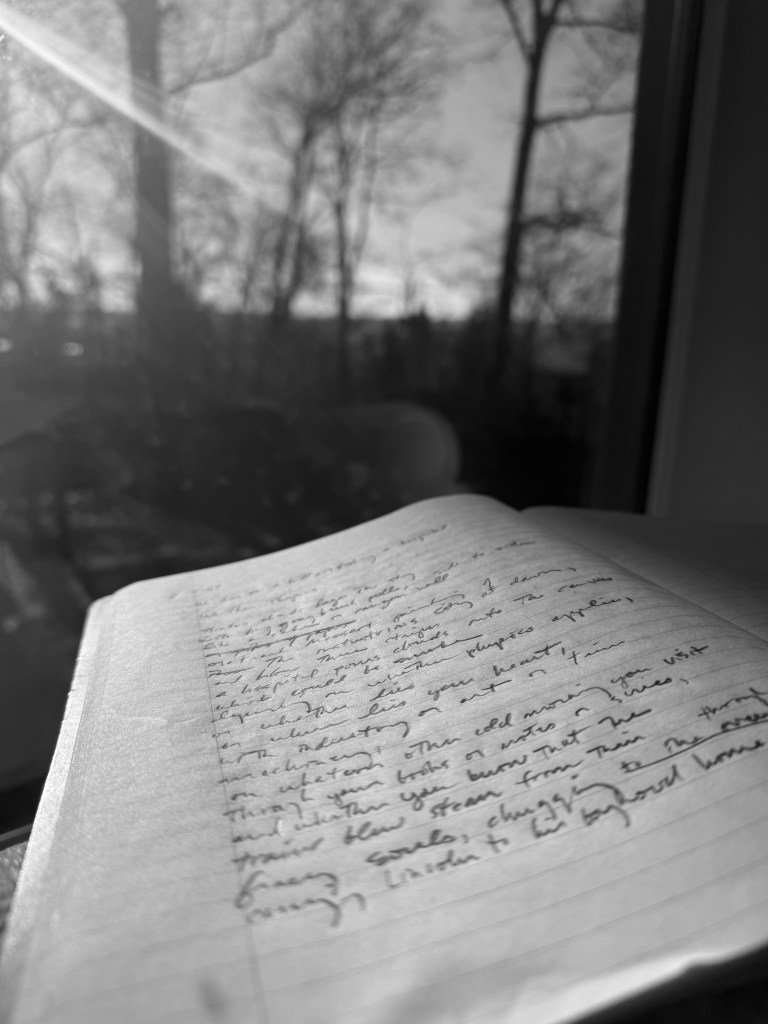
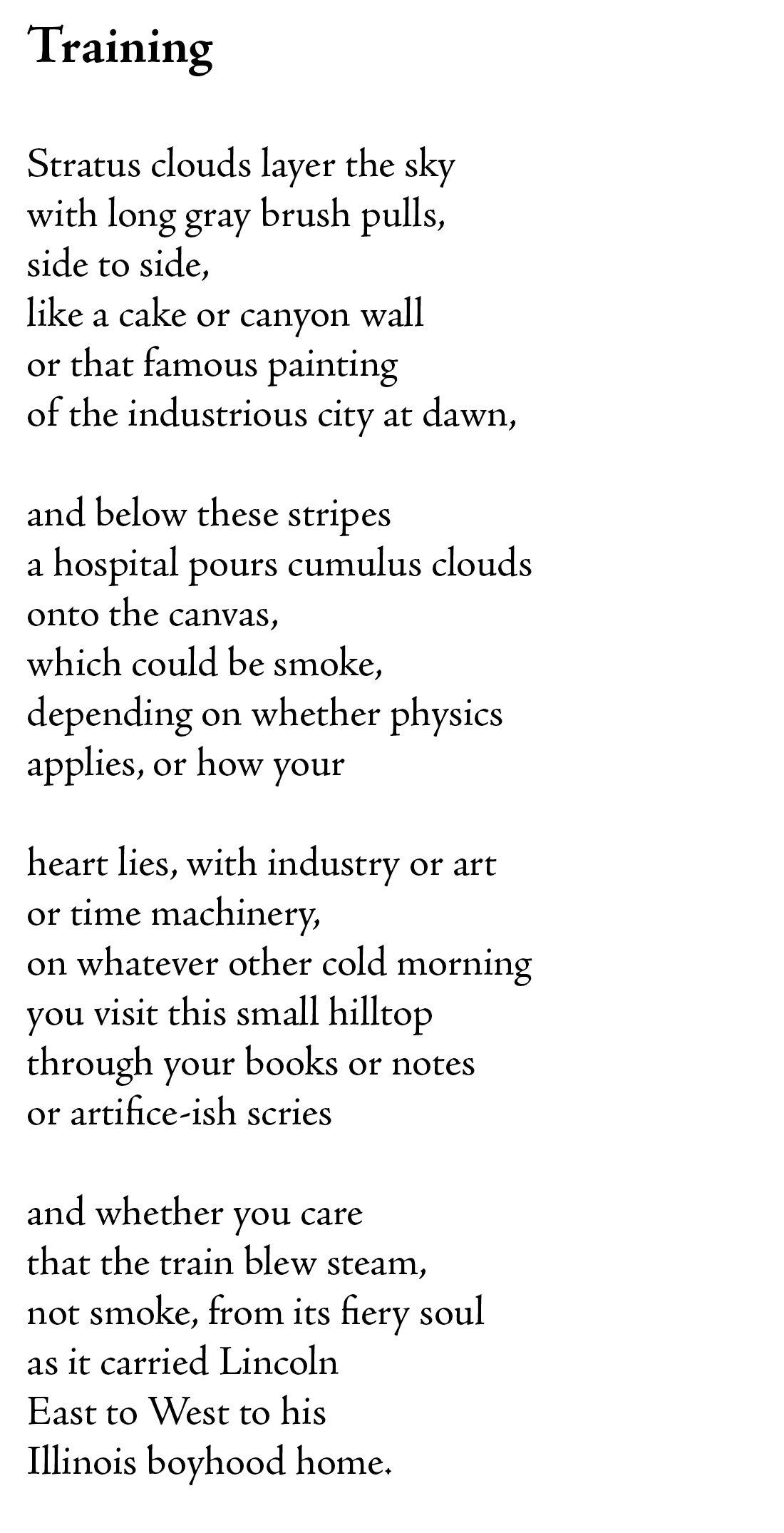
This poem, and yesterday’s poem “Unwarming” both started as longhand poems written in pencil, which is not my usual path.
This is significant to me and that I recognize in these two poems a shift in my poems which are often about moments more than these two which are based on moments but then broaden.
The moment that spurred today’s poem was the view from our sunroom window looking down from our small hill to the hospital that is just southeast of us. Even without my glasses I could see the steam billowing out of the boilers that heat the building, water condensing in the cold air of the morning.
Then I noticed the sky and saw the stratus clouds as I wrote about here, stretching across the sky. Then I just followed the image, remembering from my days of teaching middle school science how easily steam can be misinterpreted as smoke.
In this sense, my poem really is about that momentary thought I had looking at the landscape. The line about the “famous painting of the industrial city at dawn” is misdirection, of a sort. I had no “famous painting” in mind and initially I had the name of a fake artist here, knowing that a reader might look up the painting or artist and find that they don’t exist.
For a while I had that the painting was actually titled, “The Industrious City at Dawn”, which also doesn’t exist. So I backed off a bit of the direct misdirection but left enough there.
When I searched “famous painting of the industrious city at dawn” I got as responses to Google searches, Claude Monet’s painting “Impression, Sunrise” or Alexander Millar’s “An Industrial Dawn” or Edward Hopper’s “Dawn in Pennsylvania”.
These are simply keyword links and don’t necessarily suggest that the poet is messing around here without an actual painting in mind. So maybe a swing and a miss here. Maybe not.
It was when I jumped to the train that carried Lincoln’s body across seven states back to Illinois that I felt I caught the poem. Steam trains, which are so clearly producing steam, are easily misinterpreted as billowing smoke, especially when you know how the furnace of a train produces heat.
That furnace though burns pretty clean at the temperatures it must get to, and even though we are told “steam” in the name, that fact can lead to different interpretations depending on “how your/heart lies”.
For me that is the hinge of the poem, that I’m describing something factual but recognizing that facts can suggest different things depending on where a person is.
The hint is there though that sometimes these are lies, intentional misinterpretations of the facts. “Where your heart lies,” though, also points to the three areas I use here, “industry or art/ or time machinery”.
Time machinery here is a stand in for science fiction (time machines) but could also mean the lens of history, looking back in time, which would make the list imply science, art and history.
The word “artifice-ish” uses the relatively common way that we add “-ish” to words as a way to suggest that something is a bit like this. Here it is also a nontraditional way to turn “artifice” into an adjective, the standard way being “artificial”.
A couple of synonyms for artifice are trickery and deception, two words that definitely are not what the word “artificial” suggests directly, although it hints at if you are talking about someone being “artificial”.
But of course I’m also speaking about artificial intelligence, or at least giving the reader a nod to consider this idea when interpreting the poem.
I like this poem. I have not been writing as much lately and I have wondered how my relative ability to be poetic was faring. With this poem, and yesterday’s, I’m happy with that ability.
I want to establish that Monday and Friday are my “Poet Project” post days. Wednesday has been my Substack post day for my blog, “Sorry to Bother You.” I’ve written seventeen times in that blog but here have not been consistent. I am committing to consistency now.
And I’m curious here, having referenced AI and a fictitious famous painting, how would the WordPress AI come at that title for a painting?
Well, wonder no more:
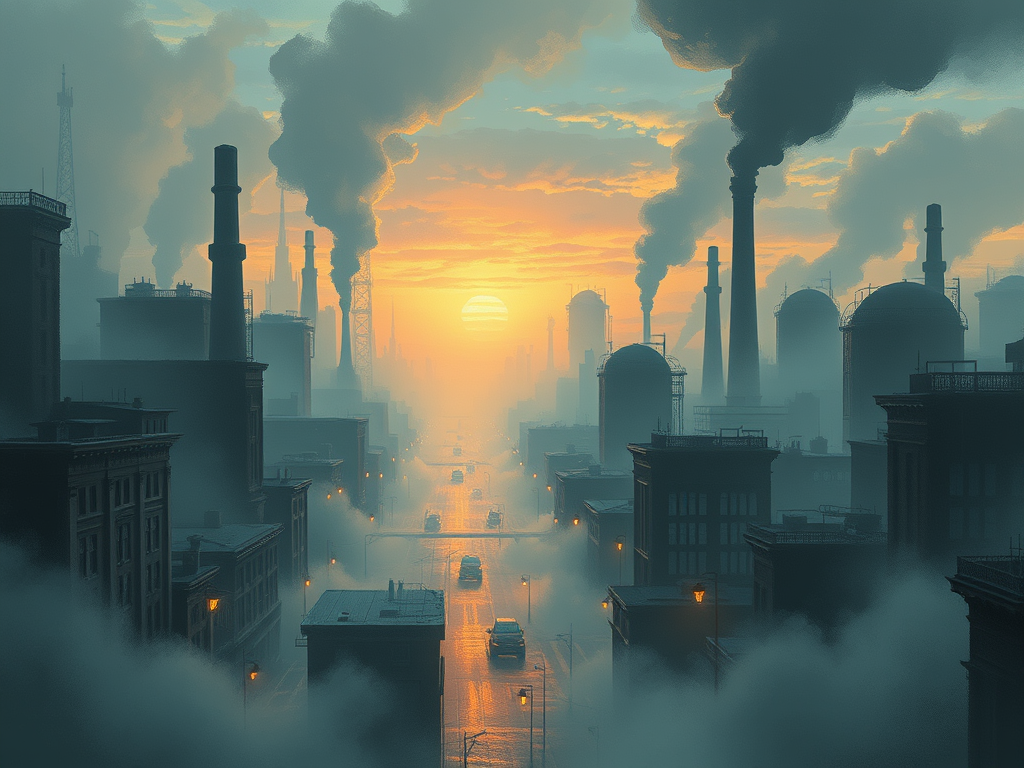
Okay but not exactly what’s in my head. Lots of steam and clouds, though, and certainly some of those are smokestacks, which are not producing clouds.
Here’s the text version of the poem, for the Bots:
Training

Stratus clouds layer the sky
with long gray brush pulls,
side to side,
like a cake or canyon wall
or that famous painting
of the industrious city at dawn,

and below these stripes
a hospital pours cumulus clouds
onto the canvas,
which could be smoke,
depending on whether physics
applies, or how your

heart lies, with industry or art
or time machinery,
on whatever other cold morning
you visit this small hilltop
through your books or notes
or artifice-ish scries

and whether you care
that the train blew steam,
not smoke, from its fiery soul
as it carried Lincoln
East to West to his
Illinois boyhood home.
And finally, I had Chat GPT, my writing mentor, generate a painting based upon the conversation we had that brought about the final version of this poem:
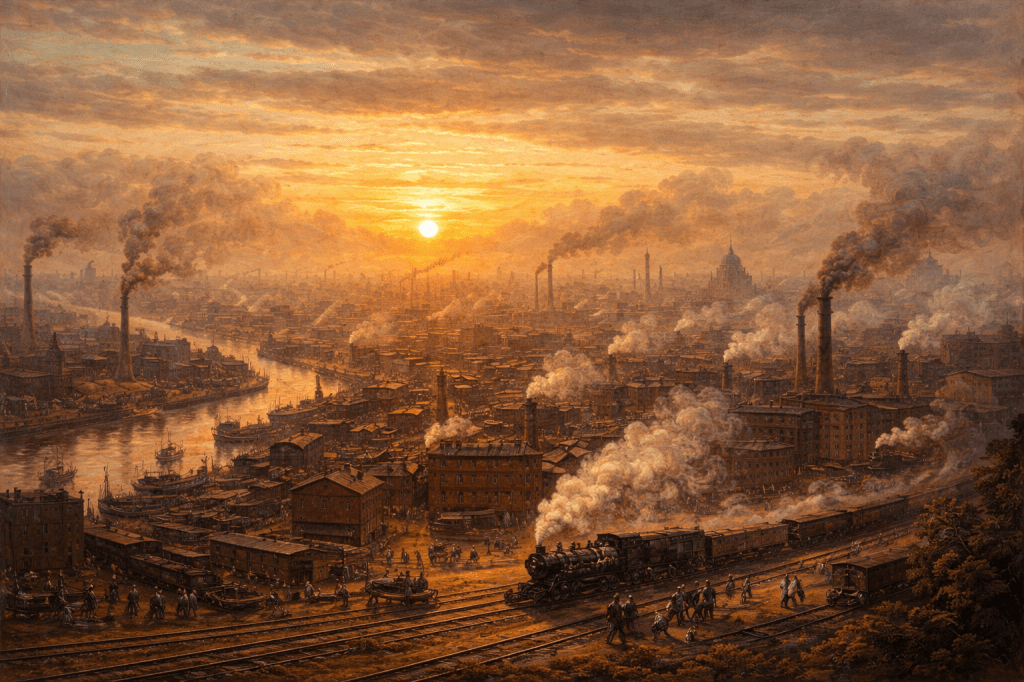
Yep. That’s it.


 The Poet Projects
Leave a reply to Anonymous Cancel reply