

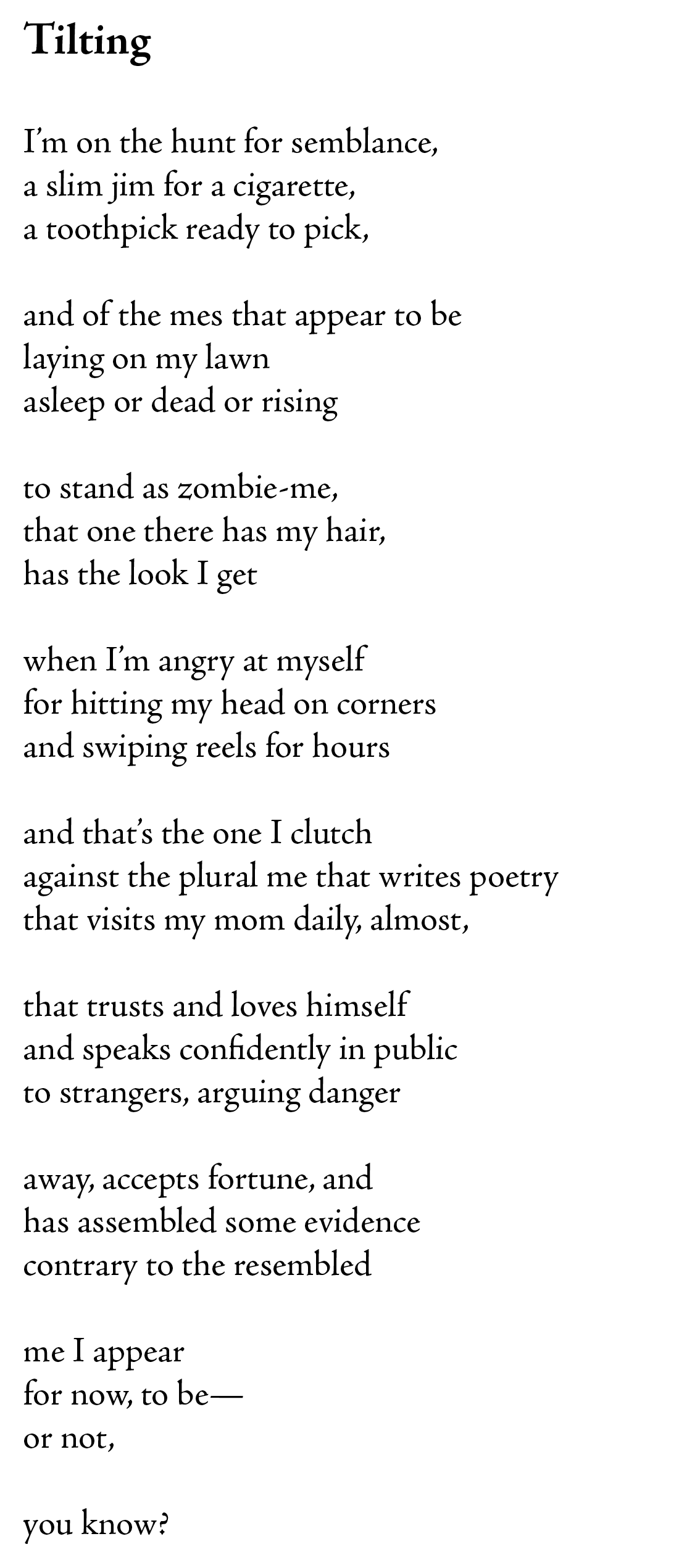
Writing about my own poems feels a bit like offering spoilers, at offering the answer to a puzzle that normally appears “on page 70” or of which to see the solution you must turn the paper upside down.
In this case, I guess, your computer, or tablet, or device.
And maybe that is what some of these commentaries tend to be. If you look at the page logo above you’ll note that it says “Vacillating Crudities” which is allusion to Edgar Allen Poe’s (relatively) famous essay, “The Philosophy of Composition” where he explains (or claims to explain) the method he used to write “The Raven.”
I want to note, though, that these commentaries often help me back into the world of my own poem later on, when I’m well past the river of thought I pulled the poem from, the intricacies of my life at the time I wrote the poem long turned to blur, the poem itself opaque without study and re-reading.
And even then, there are things I know now about this poem that I won’t know then.
Some of those things exist at the level of Easter Eggs in video games–little secrets that you can find with diligence and clues.
One such egg is that the word “semblance” includes my last name, “Lance.” The word came to mind as I wrote because of that coincidence.
But then, as I wrote, I realized that the word “semblance” is rich with meaning, a word many of us know but are not quite sure we can define, a word that has several sister words as well as cousins.
You can find these words here without much difficulty, words chosen to close inner loops in the poem, to enrich the texture and to extend the theme upon which the poem rests.
One you will miss is just word play–the line “has assembled some evidence” has assembled–one of the sister words–and an echo of “semblance” with the sound of “some evidence”.
Yeah, it’s subtle, but I put it there on purpose.
And that is one of the things that Poe emphasizes in his essay, how so many of his choices in “The Raven” were done with specificity, intentionality to achieve a goal.
I admire Poe’s essay, but I think he is either lying about the way he wrote “The Raven” or that he is kidding but not kidding–that what he claims he wanted to accomplish in the poem were not pre-poem decisions but after-poem observations.
Poe writes of writing “The Raven”:
It is my design to render it manifest that no one point in its composition is referable either to accident or intuition—that the work proceeded step by step, to its completion, with the precision and rigid consequence of a mathematical problem.
I guess this is certainly possible. I guess.
Writing about how he chose the tone of the poem after explaining that “that Beauty is the sole legitimate province of the poem”:
Beauty of whatever kind in its supreme development invariably excites the sensitive soul to tears. Melancholy is thus the most legitimate of all the poetical tones.
Ok. Sure, it’s Poe, and most of what he wrote was melancholy.
But back to my poem–after I set up the premise that my poem deserves the type of analysis that “The Raven” does–my poem isn’t too bad.
That’s me doing the kidding/not-kidding thing, my poem is good, my poem is not good like “The Raven”.
This poem’s premise of a bunch of me’s lying on the lawn is an allusion to another poem of mine, “More than they cause me”.
Alluding this way suggests that I think that poem is worthy of allusion.
Sure. Why not?
Enough. That line of explication and wry humor is taxing.
Just a last spoiler here: there is an allusion at the end of the poem to Hamlet, specifically to his famous soliloquy that starts, “To be, or not to be, that is the question.”
As Hamlet wrestles with himself in search of what it means “to be”, this poem, “Tilting” is also about that search, about the confusion I/we have as to which me is the real me, and do we have a choice here even so.
Finally, as to using “Tilting” as the title (I rewrote that a few times until it came out poetically), that is an allusion to “Don Quixote” and the famous scene of him “tilting at windmills”.
I started with “Jousting Me” as the title, a clear reference that I was arguing with myself here.
Looking up the etymology of “jousting” I saw that it was once called “tilting” and then I remembered that Don Quixote carried a lance, the main tool of the joust, and then realized that this was another reference to my name, and of course that was part of why I chose it.
And of course, you might wonder at this point, did I decide ahead of time to make two obscure references to my last name in a poem that is an examination of me? Was this really intentional or did I just happen upon this layer having already made these decisions?
And I’ll tell you–I honestly don’t know. But while I have your attention and someday my own, I’ll say it is so.
Here’s the poem again not as an image, in case a bot is crawling though my post and cannot read an image (the poem above is a .png file which I use to maintain the line breaks and to safeguard the font I want the poem to have).
Tilting

I’m on the hunt for semblance,
a slim jim for a cigarette,
a toothpick ready to pick,

and of the mes that appear to be
laying on my lawn
asleep or dead or rising

to stand as zombie-me,
that one there has my hair,
has the look I get

when I’m angry at myself
for hitting my head on corners
and swiping reels for hours

and that’s the one I clutch
against the plural me that writes poetry
that visits my mom daily, almost,

that trusts and loves himself
and speaks confidently in public
to strangers, arguing danger

away, accepts fortune, and
has assembled some evidence
contrary to the resembled

me I appear
for now, to be—
or not,

you know?


 The Poet Projects
Leave a reply to Action, reaction Cancel reply