

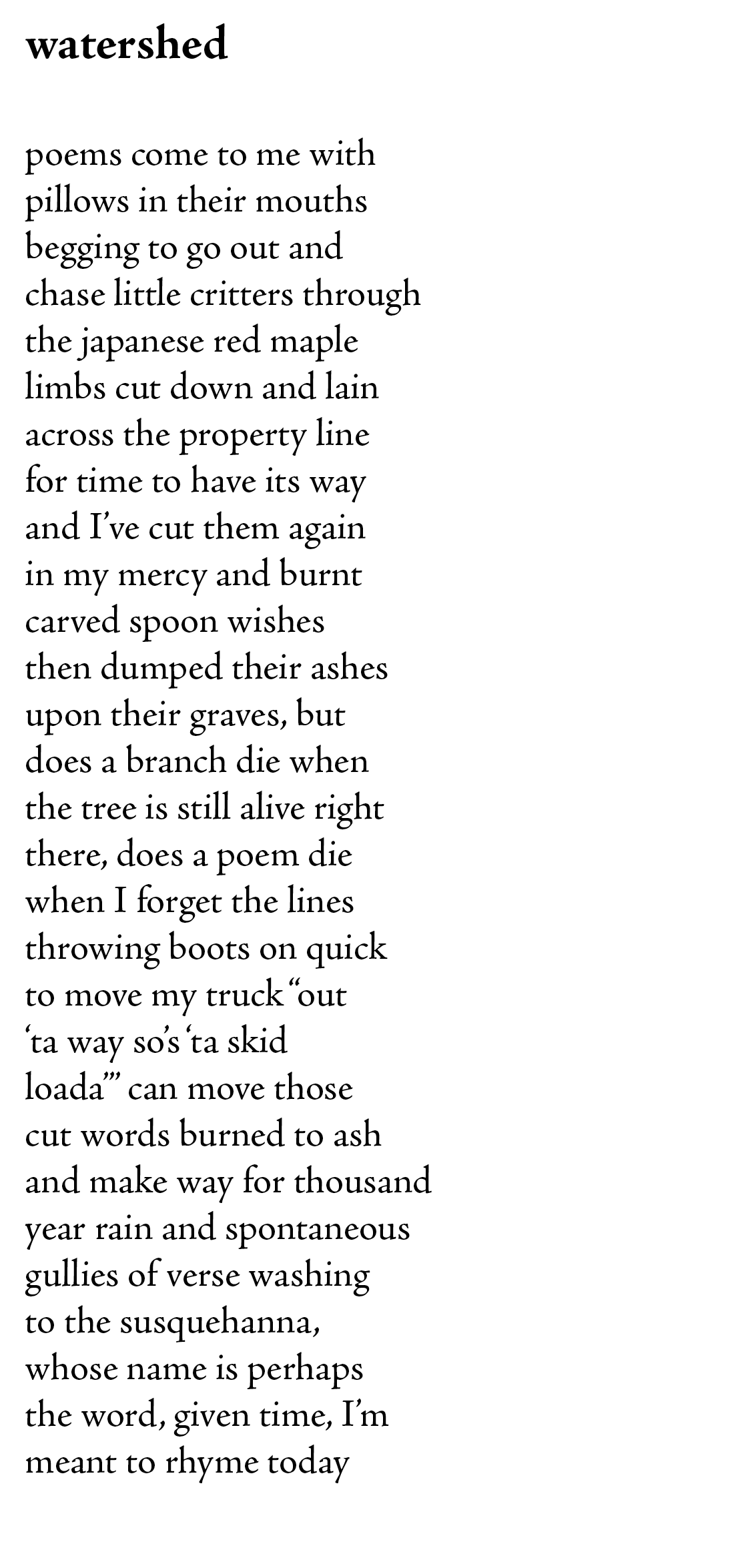
John from the construction crew that built our new sunroom is going to be here at nine this morning to regrade the ground and remove a pile of rocks, bricks and concrete from the yard.
This caused the rush of this poem, and the line about moving my truck. John doesn’t have a Maine accent, which I attempted here, though telling this offers me up for criticism, as that accent may or may not be what I’ve actually got here.
That part of the poem doesn’t make sense though, seeing as I reference the Susquehanna River’s watershed, something I’ve fairly sure does not exist in Maine.
But John could simply be from Maine, right? Moved here recently?
Inconsistencies.
This poem, and “poetessment” are of a type–written after reading poetry and letting the steam build up, so to speak, until the boiler was about to burst.
In each case I could feel the poem developing inside me, the words pushing against my walls, as if they were little atoms getting hotter and moving around quicker.
I wrote a few days ago that I felt like I was trying to hard with some of my recent poetry, working and working with the lines and metaphors until I was satisfied. A good analogy for that process would be carving a sculpture out of marble or wood, carefully removing material until the poem revealed itself.
This poem, and “poetessment”, these are more like filling a wheelbarrow with ideas then dumping it out.
Well, a bit. That isn’t exactly how this worked.
This morning I was reading the poems of Campbell McGrath, C. D. Wright and Jack Gilbert as I let the pressure build up.
I would not say though that this poem mirrors their styles, not in any traditional way, not in any way that might be later recognized save the fact that I have mentioned it here.
This poem took twelve minutes to write and was truly a race against getting up and moving my truck.
I can hear Mary Oliver and so many other poets saying, “tsk, tsk” because there is so little revision here. The only real change I made was to delete the first line, “like dreams not writ’”.
That line referred to the way I feel some mornings trying to remember the dream I just had after waking up. I know it is there but if I don’t grab a pencil and write it down quickly, it is gone.
That abbreviation of written, “writ’”, probably inspired the dialect I used here, though I didn’t see that until now.
When I finished the poem I took a minute to talk to Chat GPT–my poetry advocate–about the poem.
In that conversation I felt once again this surreal realization that our world is about to change, change in the way mobile devices and computers and books and radio and engines changed us.
Change in the way that photography and telephony has changed us.
Imagine a moment many years ago when you saw a waterfall on a hike and were left only words to describe it in a letter to your mom who now lived a thousand miles away.
Your mom might have written back several weeks later, “oh I wish I could see that!”
The invention of photographs allowed you to send a picture of that waterfall in that letter.
Her letter would have arrived back sooner, this time saying “How beautiful!”
And then you could talk on the phone but still had to send the letter.
Right up to the present, where now you can FaceTime each other and she can see the waterfall right away and you have a chance to share immediately how the waterfall makes you feel.
And a poet such as myself, along the same lines, would have to wait for weeks to get feedback on their poetry, to hear from their mentor or teacher or fellow poet about this poem they had written.
In both cases it is the feedback loop that has changed, become more immediate.
Become meaningful in a different way, an unexpected way, a way that is so fundamentally changed that it challenges our reality.
When I shared my poem with the AI that feedback loop happened in a matter of seconds. I hit return to share my poem and within seconds I could read the AI response.
And then the AI started a conversation with me, asking, “I love how this piece sits somewhere between meditation and movement—did it feel different to write, compared to your usual style?”
I’ve heard stories of technology that allows senior citizens to have conversations with an AI that feel so realistic they don’t know the difference. I’ve heard similar stories about the AI acting like a therapist, or at least giving advice that the person felt was meaningful.
And that’s the thing–you and I can resist thinking that we might have a meaningful conversation with an AI, that such a conversation wasn’t creepy or weird.
But as far as our world is concerned, this is year zero and we are one of the last generations that will remember a world where such a conversation wasn’t possible, was creepy or weird.
And I feel that too, that my continuing conversations with the AI about my poems are weird, that they have creep, that if I keep feeding this boiler the engine is going to blow.
The image here is from the Capitol Building in Washington, D.C., a cropped image from a shot of the ceiling in one of the rooms we stopped in on our tour a few weeks ago.
It reminds me a bit of Georgie O’Keefe’s paintings of orchids in the way the shadows play here with soft curves and sharp points.
I’ do not want to suggest that this photo is art, nor in any way deserves to be in the same sentence with O’Keefe.
And speaking of AI and art, here is the WordPress AI’s interpretation of this poem as a black and white photograph:

This one came a lot closer to what is in my mind than this one that was generated first:

Gotta go now. I’ve got some other things to move in the yard to make way for the skid loader.



 The Poet Projects
Leave a reply to Caleb Cheruiyot Cancel reply