

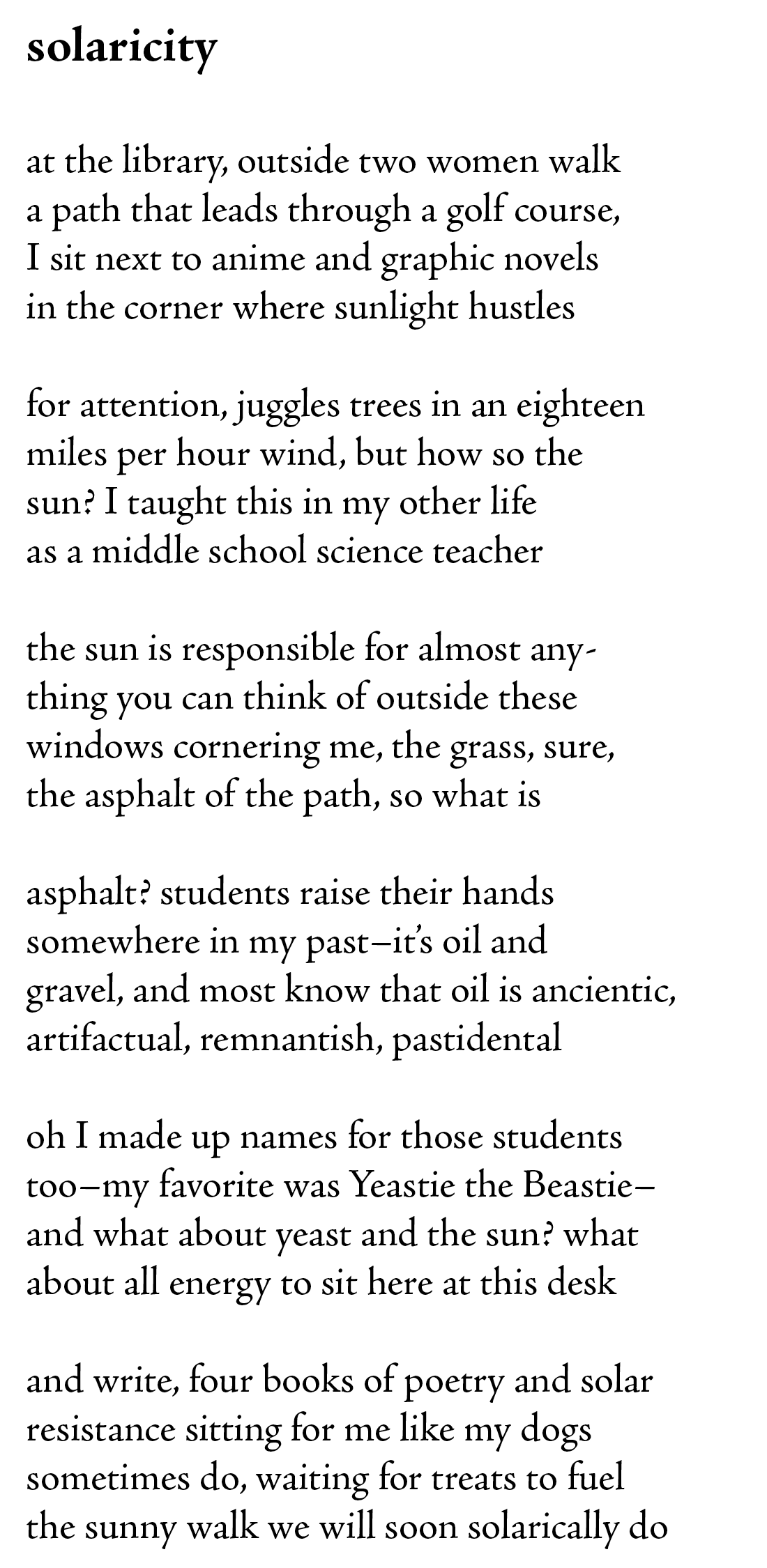
Another day, another shift in the style of a poem for me.
This poem is very of-the-moment, a snatch-and-grab of ten minutes or so sitting at a local library at a corner table with windows on both sides, looking out at a glorious windy and cold day.
I had just been outside in that wind and cold playing disc golf, keeping track of my miles walked to meet the goals for a challenge I’m doing at my local recreation center.
Motivation then is the word for the day. The rec challenge has had me exercising at a much higher rate than normal, swimming, biking, lifting and running/walking for the past three weeks, pushing my fifty-eight years into rates from my thirties.
Likewise, a library always motivates me to put myself on the shelves, so to speak. The Manheim Township Public Library has a fine poetry section–two whole shelves (or so)! I pulled four books that looked interesting and sat down at my round table.
Having the books there themselves, even without looking at them, is enough to make me want to start writing. I did, however, do a bit of reading first. I read Stephanie Burt’s book Don’t Read Poetry first, a book that teaches non-poetry lovers to better understand the incredible world of poems.
I next picked up Word of Mouth, a collection of poems featured on NPR’s All Things Considered. I landed on the section for David Lehman who started writing a poem a day in 1996 and later published a selection of those poems in his book The Daily Mirror.
There is only a small selection of his poetry here, but this poem is in the style of those, gathering observations of the moment with a light touch and little to no punctuation, making the pace of the poems feel quick and nimble.
I think I would like to do a poem a day, though I would let my style stray as it has these past few days, through Raur and Lehman, on to Oliver and Dickinson, reading and breathing in inspiration from the poems of others.
There are still some debates I’m having with myself about this poem, mostly about the punctuation. Do I really need the commas? Does using the commas make the lack of other punctuation glaring? Is the meaning more complicated without them?
I think that using them places emphasis on the places where they are used, as for instance in the list of the made-up words
ancientic,/artifactual, remnantish, pastidental
The appropriate word for the state I enter as I write, when I’m writing well, is flow. I use that term here with a reference to the Wikipedia page for the concept, making it appear that I actually have a broad understanding of the flow state, whereas I really don’t.
I only know how it feels to write at those moments.
And in the moment when I wrote this poem, the flow state helped me find this interesting place of creating words that sounded like real words, that had the parts of other real words, but were clearly not actual words.
My favorite of that bunch is remnantish which would mean, were it an actual word, something which is a remnant or some remaining part of something that no longer exists except not actually a remnant, but like a remnant.
“-ish” is a funny term that has some popularity right now, used as a modifier for so many other terms, sometimes with the simple statement of “-ish” as the response to someone else. For instance, to the question, “Are you happy?” you could reply “-ish”.
Who saw that was going to happen during the early days of language?
Ish, by the way, is not usable in Scrabble unless you actually apply it to a noun such as book, “bookish”.
On the other hand, “remnantish” would not be allowed in Scrabble, not unless you agree to it ahead of time.
This poem felt much different to me as I wrote than my other recent poems. I think that is because I allowed it to be personal and immediate. I also didn’t intentionally try to say something profound or to give the poem layers of meaning or make it lyric.
But the poem is lyric on its own, the words “poetry” and “solar” sitting side by side in the last stanza, “women walk” and “trees in an eighteen” also.
It’s too much sometimes to take a poem apart into alliteration, assonance, rhyme, sibilance, consonance. It feels heavy. It detracts from the immediate enjoyment of reading or listening to a poem.
That question in this poem “how so the sun?” is the key turning point, I think. The poem is about the immediacy of the moment–two women walking, the poet in the corner of a library, and then “sunlight hustles” which is a jarring phrase, something to give a pause to at least.
And then the sunlight is juggling trees? That’s the setup for the question, “how so the sun?” How can the narrator say the sun is juggling the trees? Is this just a metaphor for something?
My intention was that it is not a metaphor–the sun really is doing most of the work in our world if not directly then behind the scenes.
I remember writing this part, a strange thing to say, perhaps, but I remember it beyond putting the words down. I remember this insight forming in my head, giving me a chance to talk about teaching science to middle schoolers, the fun I had showing that the sun is responsible for so much in our world.
And “Yeastie the Beastie” was a flow moment of teaching for me. It was the third marking period or so and we were studying fungi. We were going over answers to a study guide while I used the interactive whiteboard to focus attention on the paper.
I often did things so that the students who were really paying attention got to have a moment of theater, where I would say something silly without a pause or draw something or pick up something and cause a distraction to my own teaching.
I don’t know why I did these things. But I did them a lot.
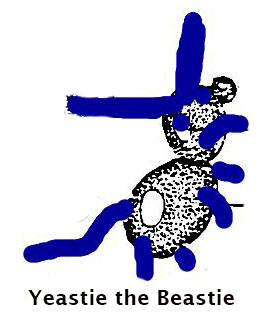
That day I drew a picture of a yeast cell including eyes and nose and fangs and very large eyebrows. I had not named Yeastie yet but there he was, this little creature that was just the thing to capture the attention of twelve and thirteen year olds. Yeastie was silly and irreverent, dumb, really, in the way that you would dismiss something silly.
But then the story took off. A different class came in and was expecting Yeastie to show up, even though I had not mentioned anything to these different students. The students were talking about Yeastie in the hallways and at lunch.
I ended up turning that original drawing into a sticker and giving one to every one of my seventh graders that year. One of the students I taught wrote an entire short story of several thousand words that she gave me at the end of the year.
Yeastie was a phenomenon, but only for us, those fifty some students and me. They have all now graduated from high school, and at this point, if they went on to college, are sophomores.
That’s a lot of context for this poem though I don’t think you need it to appreciate it.
That’s what is special for me about writing and then talking immediately about the poem in this format. I get to give the context. I get to have a moment with my reader that goes beyond the poem itself.
Here is Yeastie:
And here is the poem as interpreted by the WordPress AI engine:
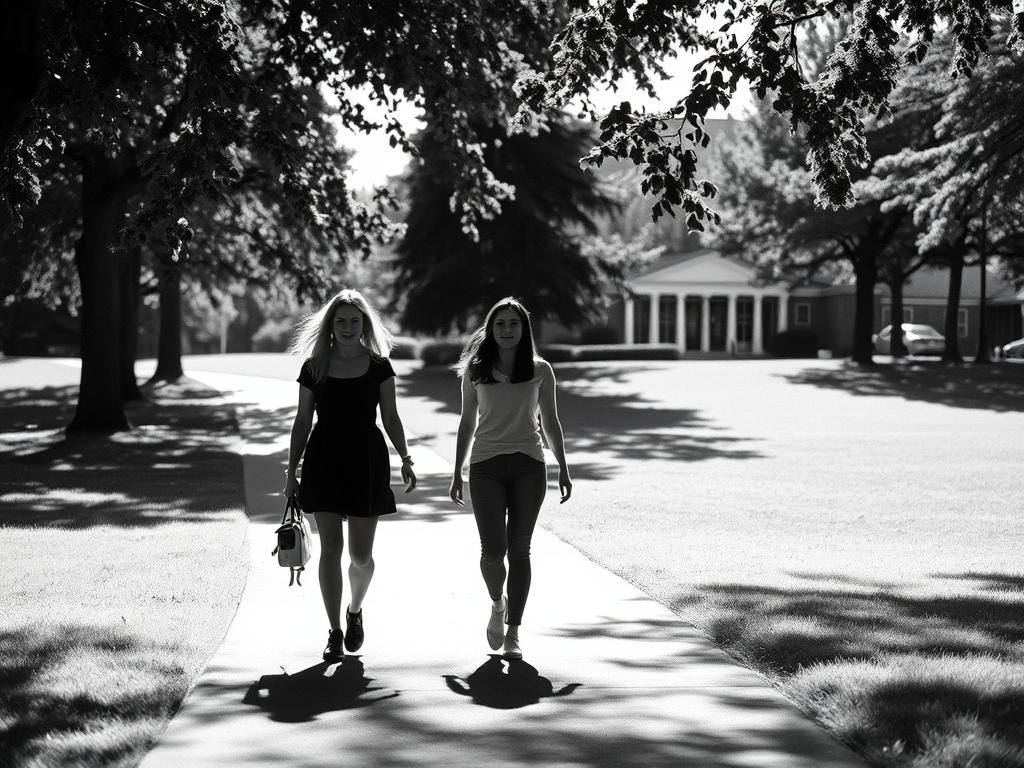
AI truly is frightening.
The image featured for this post was taken out the window of my Chevy Bolt two weeks ago. I was struck at the sky appearing to be fractured by the sunlight. The original picture which includes HDR is much brighter but the filter and small edits I did make it a unique shot as well.


Please leave a reply! No need to sign in :)