Author’s note: as I try to get my poetry/blogging life into a routine, I’m designating Thursdays as "re"–day (or Vacillating Crudities Day), where I write about a recent poem that I’ve written and give some insight into where my head was and where the poem is and isn’t successful, in my opinion.
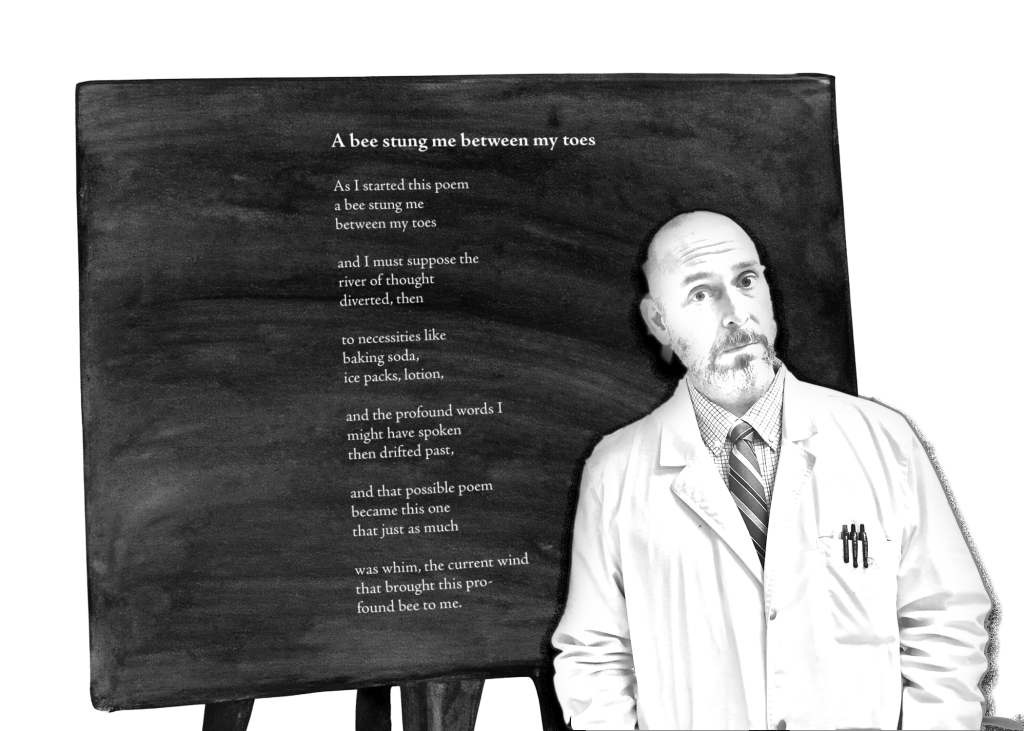
As for the muse that offered this poem to me, it is exactly as the first stanza says–I sat down outside to write a poem and a bee came up and stung me between the toes on my right foot. That led me to saying impolite things and pulling out the stinger from my toe. Then I went inside and put an ice pack on it, hauling my computer and notebook inside with me, then sitting at the kitchen table and writing.
I prefer to be outside, which is where I am now. I do not see any bees, thankfully. I’m pretty sure that this bee was targeting me, angry that I sprayed water on her this morning in my garden.
Except I spray water on the bees every morning. They have taken to gathering in a long rectangular planter in which I have several basil plants. I think that they were initially drawn to the garden for the same reason bees are drawn anywhere–the plants flower. There are no flowers now, but there is a bunch of water to be had, and I think that they are drinking the water then returning to their hive in the woods.
Our neighbor takes care of the bees in his wooden hive. They are wonderful to have nearby and they have shared the honey, so along with pollinating for us you could say they paid us back.
As for why this bee took exception to me, I think she simply got stuck between my toes. Maybe she was angry at me, but I was certainly no danger to the hive, so that’s questionable. Also, after I water the garden, and throughout the day, I walk right through all of the bees who ignore me.
They even ignored me two days ago when I made an instagram reel where I implied that I am growing corn dogs. This involved sticking frozen corn dogs into the planter next to theirs and filming. They were honey dipped corn dogs, so I can see where that might have been a trigger.
Still they didn’t sting me.
Back to the poem. I wrote down this event in the simple first stanza, breaking it where I thought it naturally wanted to be divided. As I write, I hear the poem in my head, repeating it after it is on the page, listening to it, quickly deciding if it is worth keeping.
That’s a loaded term, “worth keeping”, and writing it here I see my theory of my source of creativity needs an explanation. This is an appropriate time as the entire poem is about this process.
As I say in the second stanza, “I must suppose the river of thought diverted”, which describes my theory that a current of ideas are constantly passing through my mind independent from whatever my mind is consciously thinking.
Sometimes I envision it as waves of energy which has a sound I can actually hear if I stop to notice, a hum that is a sort of buzzing or a combination of several very close frequencies the way that a bee’s buzz does.
That current of ideas influences my own creativity, but my senses also influence it, or, as I say here, they divert that “river of thought”. As I sought to let this current of ideas influence my thinking, instead the bee’s sting diverted that thinking into thinking about ways to take care of the sting.
And in losing that connection to the current of thought, I also lost the poem I would have created, as because this is a “current” of ideas, the ideas themselves are constantly in flux, are moving both toward and away from my mind, or as I describe here, “drifted past”.
In the last two stanzas I explain that in each case the poem was born of “whim”, which the Cambridge Online Dictionary explains is “a sudden wish or idea, especially one that cannot be reasonably explained”.
In this case, of course, the bee can be explained, but I can’t explain, as you can see above, why she chose to sting me, or why she chose to sting me right then as I started to write.
That idea of “whim” is also how I think about this current of ideas that are flowing through my head. Who knows how they got there?
In either case, though, I was hoping in writing a poem to say something profound. The original possible poem and its possible profundity was lost, but the bee itself was profound, that’s for sure. In fact, I can still feel that sting now a day later. I drove my youngest son to Newark to fly to Florence, Italy where he studies later that day and my toes hurt the entire trip, noticeably and continually.
I’d say that’s pretty profound.
While analyzing your own poetry, it feels opportune to suggest that everything you wrote was intentional, that every nuance and possibly every single syllable combine their effects to produce one profound effect.
So, I could say that using the word “suppose” was intentional in the second stanza, but when I looked back and saw it, after posting the poem here, I felt like I saw it for the first time. Seeing it then changed how I thought about the poem, suggesting that the diversion of the river was something I wasn’t sure about.
But that’s the perfect meaning I wanted, I see now. Yeah, this is my theory, but it doesn’t explain everything, and is anything but a comprehensive analogy for this process.
So I suppose this is true for all poets and writers, that we create but are not totally aware of everything we create, not every effect and meaning is intentional.
I also see now that the word “then” in the second stanza should have a comma after it. It works the way it is, but it deserves a comma, especially as it comes after the word “diverted” instead of before. The phrase could have been “the river of thought then diverted to necessities” but I wrote it as “the river of thought diverted, then, to necessities”.
The comma usage here is really a choice of having the reader speak the words the way I hear them in my head.
Which gets me to the structure of the poem, seven stanzas of three lines with the first line having six syllables and the next two have four each.
This is not a structure of any poetic type of which I know or have ever encountered but neither do I think it is a type that needs its own name.
So why did I choose this structure? In a word, “whim”.
Really, it is the way that the first stanza went onto the paper. I didn’t count any syllables or force any rhymes, but I can see now that they are there, and that the 6-4-4 pattern allows the rhymes to add to the effect. “bee stung me between” has four long “e” sounds. Also “poem” has the long “o” sound as well, giving a rhyme between the first and third lines.
I didn’t concentrate much after this to maintain this pattern. I’m sure it could be done, but the pattern for me was just a challenge that forced me to rework lines until they fit, to tap back into the current of ideas. I wanted to break the rule a few times, but I stuck with it and in the end came up with a better poem than I might have.
There are plenty of other rhymes here that are intentional, such as “lotion” and “spoken” or “whim” and “wind”. In so many ways that’s the type of rhyme that makes sense to me, rhyme that ties thoughts together but doesn’t dictate the direction of the poem.
The poem is meant to be playful, and having rhyme tries to keep it that way.
After all, just because something is profound doesn’t mean it can’t be fun.
Here is an alternate ending for the poem that I wrote, for what it is worth. I tried to tie the word “currency” with the word “current” and suggest that there was a price to be paid for using the river of thought this way.
was bought with currency, which for bees is simply honey.
It felt too cute and inexact. A distraction, really, from the meaning I saw in the poem when I finished. Also, it was a bit too clever. It’s ok to be witty and have fun, but not in a way that sacrifices the essence you as a poet are after.
So there you have it. I hope to find you back here next Thursday for a look behind the scenes.
2 responses to “Re “A bee stung me between my toes””
Cathy Williams
This is a wonderful concept and I look forward to reading more. I loved the line saying profound things can be funny! So many of us struggle to believe that but in my opinion you’re spot on. Welcoming that brings me a feeling of freedom and brings great joy!




Please leave a reply! No need to sign in :)