

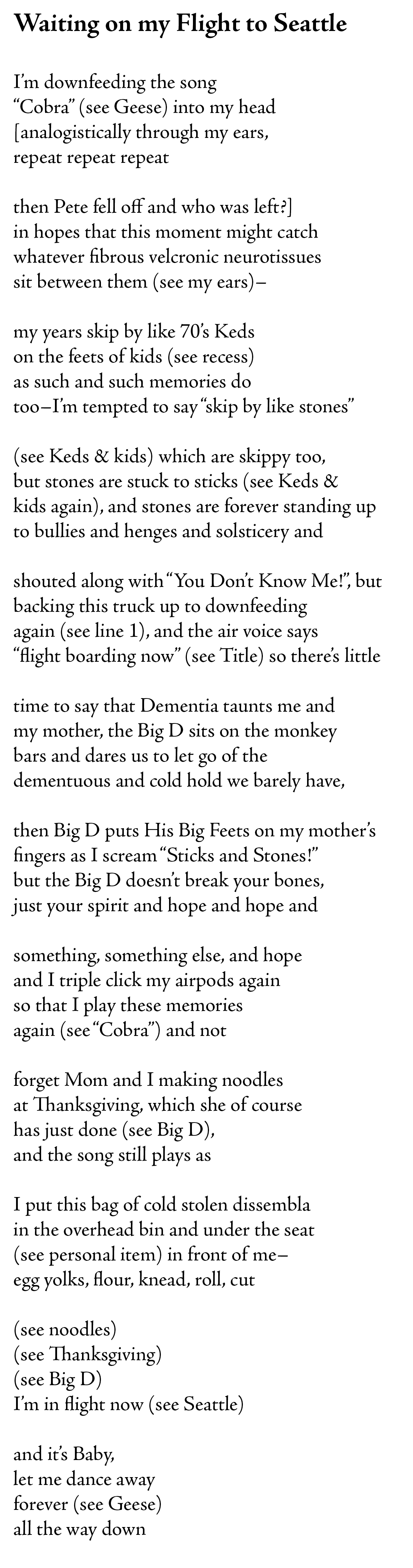
I hope you enjoy this poem. I think it might be a tougher one to understand, though maybe that’s what turns you on, Seinfeld. Maybe that’s how you get your kicks, you and your good-time buddies.
Sometimes I can’t help myself.
This poem actually is a great example of letting my mind follow threads and then bringing them back together as the poem concludes.
That’s the part which I think might be confusing.
Let’s take the first two lines–
I’m downfeeding the song
“Cobra” (see Geese) into my head
I have a neologism here, “downfeeding”, a last minute change that helped direct the reader more than the first word, “downloading”.
Downloading was the start of the entire poem, the word that brought the whole thing to life on the page. I was waiting for our flight to Seattle (see Title). My son had just sent me the song “Cobra” by the band Geese and I was listening to it on repeat. And that process felt like a download into my brain.
But there is a cleverness about the word “downfeeding”, especially in conjunction with the band Geese–the word “down”, the idea that you are “feeding” the geese.
But this is more the way you take a song and embed it into your brain, listening over and over and over until those moments you spent listening are attached to the song.
I realized this first when our kids were much younger and we were on a vacation in Maine. Coldplay’s album “Viva La Vida or Death and All His Friends” had just come out. I put the album on repeat both on the car ride and on the stereo in the cabin in which we stayed for a week.
I can listen to those songs now, especially the ones I have not really listened to since like “Viva La Vida” and I’m transported there again, our children still kids, our dog Waldo still alive.
So I’m still on this trip to Seattle to visit my son Oliver and our future daughter-in-law Tess. We had a wonderful and small Thanksgiving. We went to a UW vs Oregon football game. We did a short run around Green Lake.
And for the soundtrack I played “Cobra” about fifty times.
And I know this is obscure, a detail that a future audience might not know and that will probably diminish the poem for them.
But that’s an issue with all poems–if you know what the poet’s motivation was to write the poem, if you know the details of their life that brought the poem to life, well then all poems might have a glow that otherwise they could not have.
And there are schools of literary criticism that would ignore the commentary I’m offering now, that believe the poem, once published, must support all interpretations on its own.
In my undergraduate English degree we didn’t study too much literary criticism, though we touched on it in some classes, enough that I knew there were different schools and that those schools were at odds with each other about this idea that the life of the author should be included in the attempted understanding of a poem.
Even knowing that, these commentaries are important to me and are a form of processing the poem personally.
I can explain things that I want the poem to mean, but just because I have intention to explore these things doesn’t mean the poem has conveyed them.
These commentaries are also my attempt to be transparent in my process of writing. They are a “How I Built This” explanation (see Guy Raz’s podcast of the same name) except that there is no interview here.
I’ve thought about having as series of questions that I would answer, but I think that would be limiting and ultimately boring.
I wrote this poem in a novel way, listening to the song “Cobra” the entire time, over and over and over again.
Normally I want total silence. No distractions.
But I was in an airport lounge with hundreds of other people traveling for the holidays.
The song became the silence.
In fact, I’m listening to it right now while in the background college football is on the television.
I played with a novel type of footnoting using parentheses (see Poem), a technique that I could, perhaps, let become my signature.
I’m not sure I want that. I love this here. Along with coining several new words (downfeeding, velcronic, dementuous, dissembla and solsticery) it creates an atmosphere where I am able to be tongue in cheek but also intense, as when I talk about Big D on the playground at the same time that I am speaking about the way dementia is affecting my mother.
The word “Solsticery” her is a reference to a poem I wrote of the same name. I guess I’m making claim to the word.
I love that The Big D showed up as I wrote, that I found a personification for the disease which feels real, that’s the perfect name for a bully, the name a bully might call himself or herself, a type of third person speak that has quite a bit of comedy around it.
This was a tough section to figure out for me, to think through the motivations of Big D on top of the monkey bars, watching my mom and I holding on the money bars afraid to drop, not knowing what dropping might mean.
Having The Big D say, “I dare you to let go” is where I landed. There would also be a story where the Big D doesn’t want us on his monkey bars and steps on our fingers to make us drop.
This brings me to mention something that just occurred to me–why would The Big D need to be logical? Why would there be any logic in his/her bullying?
The simple answer–there wouldn’t be any logic at all. The Big D can never be trusted. The Big D’s motivation is always obscured except that The Big D isn’t here to be your friend.
And I am aware of the use of the phrase “Big D” as a term to describe a man, used in the phrase “he has big d energy”.
I suppose that all people with big d energy are not bullies. I certainly won’t accuse them of such. But I don’t mind that my name for dementia here, Big D, has that connotation. It doesn’t hurt what I’m saying here.
The use of the song here and some of the lines from the song (the first three lines of the last stanza are from the song) seems too coincidental. I was listening to the song a few times before I wrote, but that the song works so well here, which I think it does, seems unearned.
Or, I didn’t like/respect/know this song long enough to have included it as a significant part of a poem that I have worked on so long, that I am presenting as worthy of reading.
But then what stories and memories and experiences do I have that are earned to such a degree? Is there a number of minutes one should listen to a song before you can allude to its lyrics in conversation or even further in written work?
I’m not sure that the word “analogistically” counts as neologism, but the word does not exist.
And I’m about to take credit for using the word in such a nuanced way for which I really shouldn’t get credit, because I only realized it just now. That nuance is that the core word “analog” can both mean non-digital as well as a person or thing that is comparable to something else.
The non-digital meaning was fed more directly when I was using the word “downloading” for this process, but even with “downfeeding” the suggestion is there and the word works well.
And the second meaning is all about metaphor, relating one thing to another, an essential tool for all poets. There are plenty of metaphors in this poem, things that are suggested directly and things that are implied.
I love how the picture that accompanies this poem came out. I took it while at the Space Needle end of the monorail, both of which came to Seattle for the 1962 World’s Fair. The left side of the picture is a convex curved mirror that allows someone to see a large area quickly. I lined myself up so that I could see the Space Needle in the mirror and got this shot which works well in black and white.
And as I wrap this up, fittingly I’m sitting is SeaTac Airport waiting on our flight back to Pennsylvania. And of course you know what song I’m listening to.
All the way down.
and for the bots that crawl this poetry blog, this text version:

Waiting on my Flight to Seattle

I’m downfeeding the song
“Cobra” (see Geese) into my head
[analogistically through my ears,
repeat repeat repeat

then Pete fell off and who was left?]
in hopes that this moment might catch
whatever fibrous velcronic neurotissues
sit between them (see my ears)–

my years skip by like 70’s Keds
on the feets of kids (see recess)
as such and such memories do
too–I’m tempted to say “skip by like stones”

(see Keds & kids) which are skippy too,
but stones are stuck to sticks (see Keds &
kids again), and stones are forever standing up
to bullies and henges and solsticery and

shouted along with “You Don’t Know Me!”, but
backing this truck up to downfeeding
again (see line 1), and the air voice says
“flight boarding now” (see Title) so there’s little

time to say that Dementia taunts me and
my mother, the Big D sits on the monkey
bars and dares us to let go of the
dementuous and cold hold we barely have,

then Big D puts His Big Feets on my mother’s
fingers as I scream “Sticks and Stones!”
but the Big D doesn’t break your bones,
just your spirit and hope and hope and

something, something else, and hope
and I triple click my airpods again
so that I play these memories
again (see “Cobra”) and not

forget Mom and I making noodles
at Thanksgiving, which she of course
has just done (see Big D),
and the song still plays as

I put this bag of cold stolen dissembla
in the overhead bin and under the seat
(see personal item) in front of me–
egg yolks, flour, knead, roll, cut

(see noodles)
(see Thanksgiving)
(see Big D)
I’m in flight now (see Seattle)

and it’s Baby,
let me dance away
forever (see Geese)
all the way down
 The Poet Projects
Please leave a reply! No need to sign in :)