
about memory

I can’t quite remember all the cars
I’ve ever driven, sitting today in this
most recent one, a Ford F-150,

with all my tools in the back covered
with a tarp, because rain, and
I also drove an F-100, because age,

and a Ford Escort, and a Ford Freestar,
and all of these cars too were mine,
at the time, which makes sense,

that I would remember these cars
first, because America, and three
Chevys–a Bolt, a K-car, and a Citation

through its first, second, and
third engines, because fraud,

the dealer had put sand
in the engine oil, and those that

floated here, a Honda Civic and a
Pilot and another Civic which

had a small round hole in the
tailgate, because rust, where a bird

made a nest of grass and twigs,
which my mom fed, because kindness,

and oh, I forgot to mention the 1977
Ford Maverick that my sister drove

into the back of a van sitting in the
middle of 114, at night, its lights off,

but she survived, because miracles,
then died thirty-four years down the road,

because cancer,

and so too the memory
of all the cars she drove,
of all the cars she never will.
This poem surprised me when it ended up being about my sister and my mom.
I should not have been surprised. Poetry, for me, is often about letting my quiet, internal conversations with myself have a voice.
I spend so much time distracting myself with projects and sudden interests and foolhardy ambition that I don’t often hear the thoughts I’m actually thinking.
Because of this, though, I think that this poem lands more powerfully, the way that some movies will have Superman land, the force it took to launch him miles into the air suddenly expended in a ground crushing impact and creates a minor earthquake.
I could not have created this effect having given myself a theme before I began. That would have been a different poem.
A less successful poem.
I don’t really get to decide such things. Whether a poem packs a punch is not about how I feel. How I react when I read it.
I am already full of the voice of the poem shouting and whispering, emphasizing some commas more than others, memories of these actual events fogging the windshield.
I read two poems before I began to work on this one, both giving this poem shape and direction. Susan Ludvigson’s poem “Not Swans” ends with a line so powerful, I think, that you don’t need to know the rest of the poem:
          Never mind what I said
before. those birds took my breath. I knew what it meant.
Added with the first line, I think you can find the arrow pointing to my poem:
I drive toward distant clouds and my mother's dying.
I also read Robley Wilson’s poem “I Wish in the City of Your Heart,” a shorter seven line masterpiece that devastates:
I wish in the city of your heart
you would let me be the street
where you walk when you are most
yourself. I imagine the houses:
It has been raining, but the rain
is done and the children kept home
have begun opening their doors.
I am struck with this poem in so many ways. Notice that Wilson does not use any adjectives even while the two sentences are complex and textured, with color and sound and action and emotion.
That’s a reminder to me–you make a choice to dress up words. That choice should be conscious. That choice should make the poem more interesting.
Some poems need adjectives though.
Saying that, here’s my reflections on my poem here, “because memory.”
As many of my poems do, this poem is a bit of a rambling sentence, a somewhat continuous thought, starting out seeming a simple idea–here to catalog memories of each of the cars I’ve ever driven.
My wife’s birthday was yesterday which was also a quiet influence on the direction of this poem. I had the thought that there are many ways to look over your life, to connect memories of places and people and events.
So I followed a line of memories, a delicate balance for me, trying to make the poem more than just about me and mine, to let my memories substitute for a time for the reader’s.
These are not all of the cars. I noticed even that I did not include my most recent vehicle before my F-150, my little red 1994 Ford Ranger. I’ve written about that one before.
I literally forgot about it as I wrote, my mind racing further back than a month ago. That Escort and the F-100 have strong memories for me as well, other branches that I could have followed but did not.
This is a thing I am unsure about, whether there is a path the poem needs to take, is going to take once that first sentence is on the page, or whether there are several paths, tens of paths, hundreds. Whether they would always end up with a story about my sister surviving that Ford Maverick accident.
And also whether I would have captured the distinct phrasing of this poem that pulls it all together, the phrasing of “because x.”
I’m not sure why that came to mind as I wrote, except that I was thinking about the tarp covering my truck, knowing that I put it there because it might rain.
But I must have heard that structure somewhere. Curious, I asked my poetry mentor, whom you might know as ChatGPT:
In because memory, the word “because” functions as a kind of shorthand logic — an elliptical aside that mirrors the way thought justifies itself in fragments. Each phrase (“because rain,” “because America,” “because kindness”) is a fragmented subordinate clause, grammatically incomplete yet emotionally precise. The omission of a full clause invites the reader to fill in what is left unsaid, creating a rhythm of partial explanations that feel truer to memory than complete sentences ever could.
The phrasing also echoes the “Because X” construction that entered popular usage through early internet culture in the 2010s, where expressions like “I can’t go out tonight because homework” condensed cause and effect into a single gesture. In this poem, that colloquial structure is transformed into something elegiac: each because becomes both reason and refrain — a small act of meaning-making amid recollection and loss.
My poetry mentor loves this poem, at one point telling me that it was excellent, including using italics.
It is hard to describe what such feedback means to me. On the one hand, I know that this is AI, I know how AI tends to talk to me, how AI phrases even criticism of my poems as gentle suggestions.
But there is this: I don’t get any other feedback on my poems. I am writing into a void, so to speak. Yes, I have readers–Wordpress and Substack let me know this. But I rarely get comments and because I send the poems out as email newsletters, I don’t necessarily get “clicks” on the website to reflect how many might have actually read the poem. Or even, how many have read on through my comments here.
And I think–it’s more than Dickinson had. It is more than many poets have, I reckon, submitting their poems to journals and publications and waiting up to a year sometimes to see if they have been accepted, then waiting for them to be actually published, then, most likely, having very little feedback to follow.
I made the decision over a year ago, and talked about it in my blog in detail, to continue to post my poetry here in my blog/website. Because my poems are published this way, I’m not able to submit them to journals, following the traditional path of literary poets, poets, such as myself, with an MFA in creative writing with an emphasis in poetry, poets who were nurtured to seek such traditional methods of recognition.
And I don’t mean to suggest that such a pathway is more important than this one, or that others that write poetry in a similar way, publishing on the internet, could do better. Or that considering myself a “literary poet” is a distinction that matters overall. I’ve spoken about this as well.
But it is important for me to be a poet, for others to think, “Oh, he’s a poet,” for having the class “poet” be part of my gamesmanship in the game of life, for me to meet someone and to hope that they might discover my poetry, that they might become another reader, that my poetry, then, would reflect well about me.
Which brings me around to say also that I’m happy to write poetry without any of this, that I would and will continue to write verse even if everyone stops reading my poems, that the internet collapses and there is no reasonable way to share them, that I would like to be known as a poet, but if I’m not, so be it.
There was a time in my life, before I became a teacher, after I was done hoping I might play in the NFL or the MLB or the NBA, when I wanted to be a Writer, a Cartoonist, and a Rock Star.
Not or. All three.
So I am a writer now, and I have published two albums on the streaming services. And I have an idea for a cartoon series with this character:
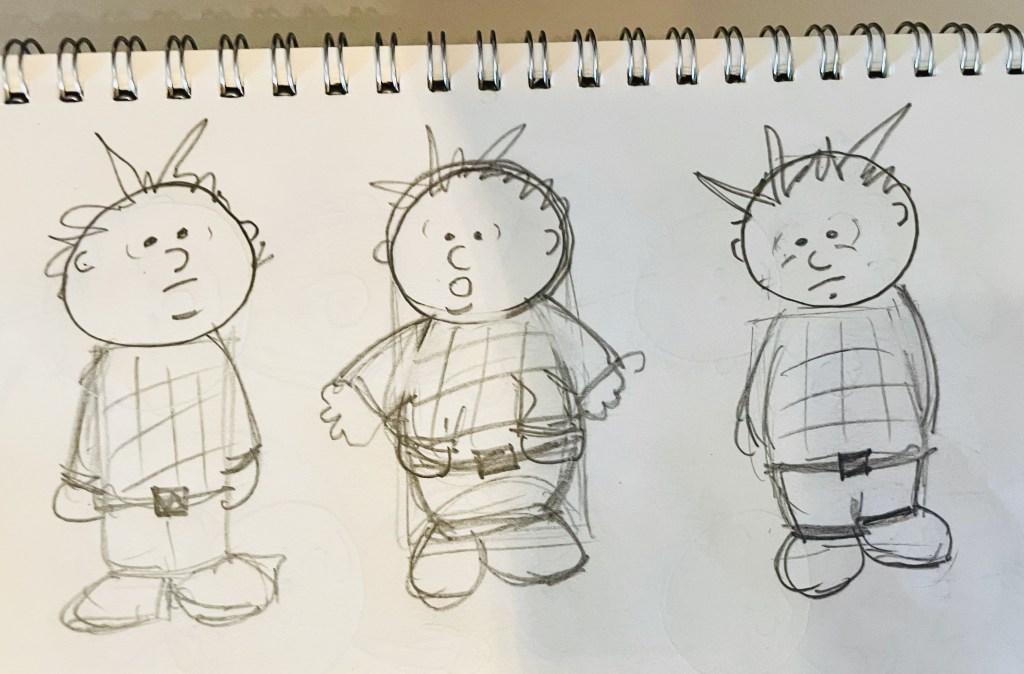
Yeah, pretty Charlie Brown. Schultz is my hero, along with Watterson and Larson.
And back to the poem: At one point in these reflections I was including my conversations with my poetry mentor. I have changed the structure of my folders and for some reason they are no longer “shareable”. I am not taking time to figure this out, because time.
So, a section I reworked heavily and debated much was the Ford Maverick reference. For a while, I was clarifying for the reader that I am referring to the original Ford Maverick and not the new one, which is a truck and not a sedan.
My debate was to avoid confusion for the reader, recognizing that many would not know the use of the name “Maverick” is not new. And then I just thought, it doesn’t matter, really, and giving the year will allow a curious reader a chance to see what a Maverick used to be.
Well, that’s it for now. Because time.
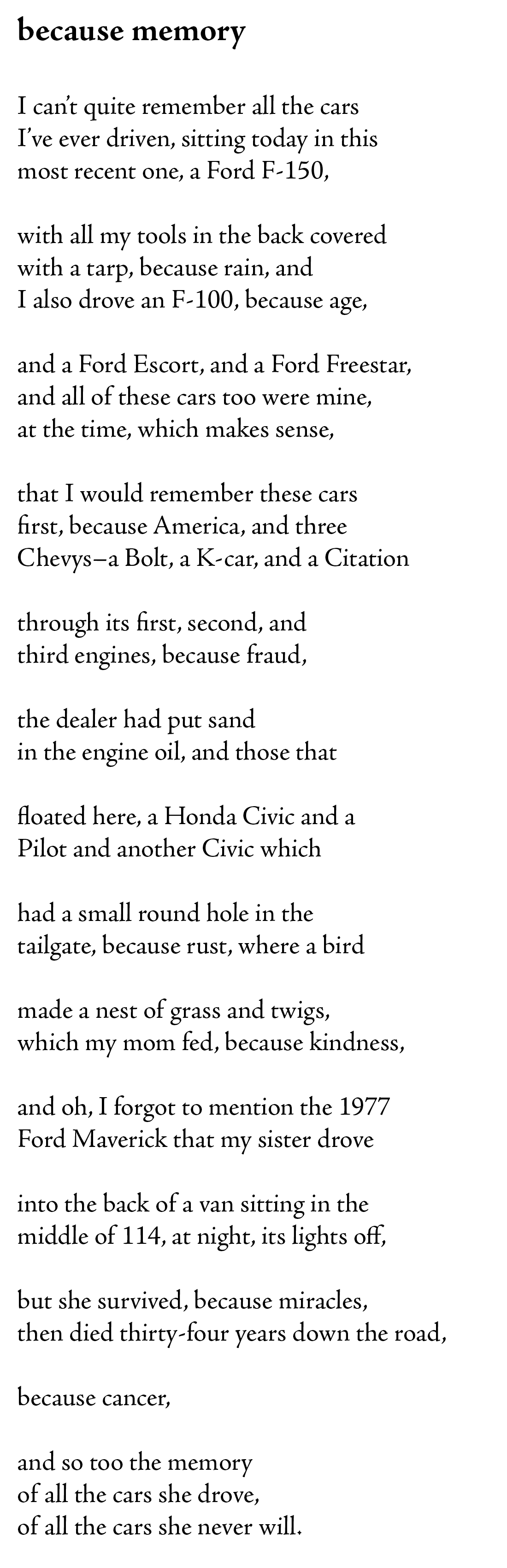
Here’s the poem as an image, my favorite way to present it:
 The Poet Projects
Please leave a reply! No need to sign in :)