

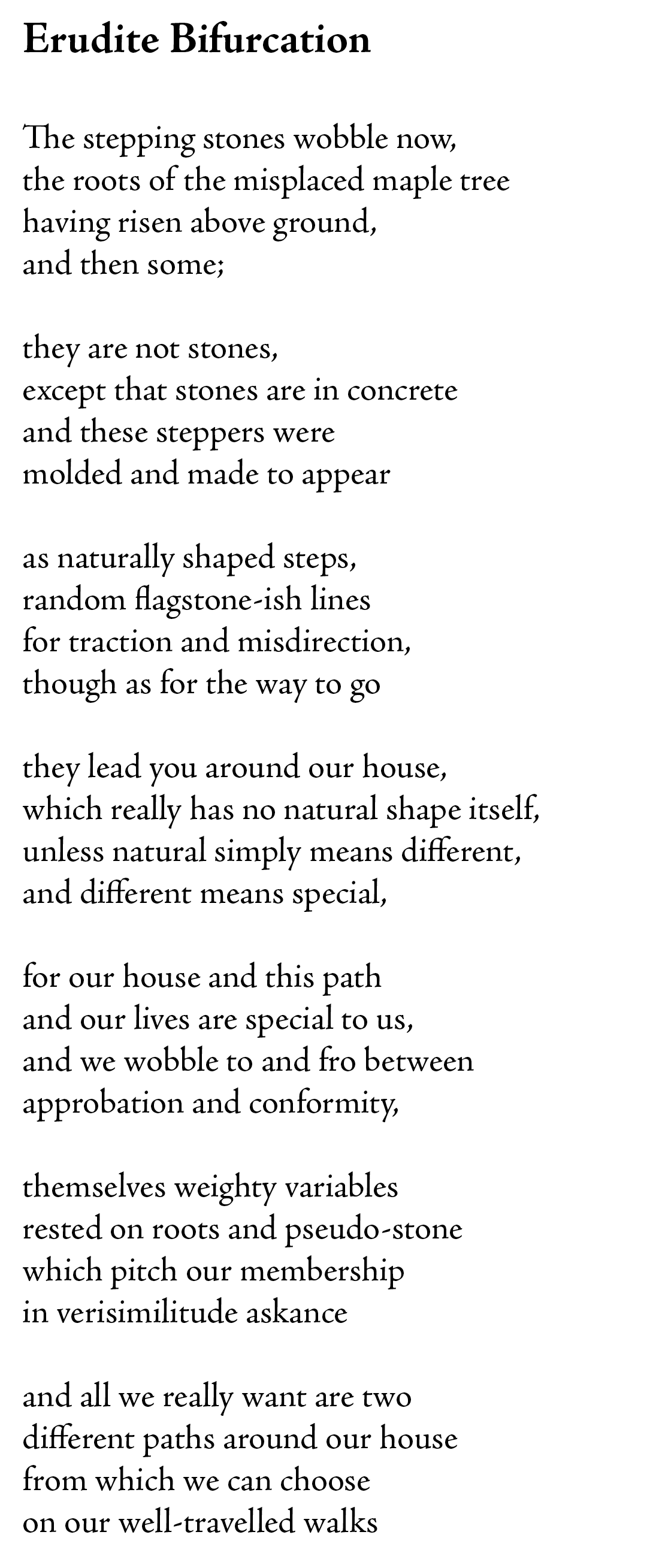
Right as I started this poem, I thought a bit about creativity being drawn from a moving river, the river representing the muse that offers up ideas, constantly changing, the concepts mere whims in reality.
And at that moment I looked out my window and saw these stepping stones, including the two or three that really wobble, that rest upon the roots of a maple tree that have, for some reason, decided to come above ground.
The tree is misplaced–if we could go back fifteen or so years, maybe more, I’d put it somewhere else. As it is, it is right next to our deck and though it offers a delightful canopy of shade, it also attracts spotted lantern flys this time of year.
And these flies are beautiful, on one hand, and on the other, nasty invasive pests.
I’d say that they are almost all invasive and nasty.
But that’s the theme of this poem, that some this or that interpretation of something exists for so many things–steps, words, paths.
Having that stone wobble causes a slightly different path around the house.
If only one step wobbled, there would be two paths.
But because many stones now wobble, a power of two effect happens, and each step leads to an exponentially larger possible path.
That was one possible title for this poem–“Exponential Eruditity”–though I think that this mathematical reality is perhaps overstated, as really there is barely a difference.
I think that’s the point, though, that there is only a wobble between things, one that is much more random than chosen.
That last stanza is a direct and not-too-subtle shout out to Robert Frost’s “The Road Not Taken” which I’d guess you all know well.
I chose to suggest that there are two paths which works against my power of two idea, but it’s still there if you look.
The writing of this poem also was a wobble. I could have written about the wood pile (as opposed to the stack right next to it) and how it got there, why I have’t taken the time to stack it, how there are critters living in there now–mostly chipmunks other than insects.
As for the erudition here, moving from a more casual and simpler start to the poem into the weighty world of dictionary words is itself a wobble.
I might have stuck with such words the entire time. Or might have stuck with a more conversational vernacular.
The last two stanzas also are more lyric than the earlier ones. There is the internal rhyme of “pitch” with “membership” and the both consonance and rhyme in the last two words, “well-travelled walk”.
I really like the way that last line sits as both lyric and allusive, the most direct notes of Frost’s poem in the entire poem.
For a while I had the word “disestablishmentarianism” in the poem as part of the play on erudite words. It was too much, especially as it doesn’t really mean to remove yourself as a member of something non-religious in nature.
It is too easy for me to be clever in a non-productive way in my poetry, in a way that obstructs the fluidity and directness I’m usually seeking.
I took the image here of the Cooper’s Hawk from the front seat of my truck at 25x. The original is a bit more than out-of-focus.
I ran this through Chat GPT and asked to have it rendered in black and white as a sketched image.
I took that image and cropped it and voila.
This has me thinking about the authorship of the image–is it really mine now? Can I claim that this is my editing of my own photo and that classifies as my own piece of art?
I guess I would mostly make the argument no, it doesn’t. There is too much here that I could never do without help from the AI.
Except that almost all of my images are aided in so many ways with algorithm and canned filters. Almost all images that you’d see now are, and are becoming even more so.
I thought of this a few years ago when I taught a STEM course to my middle school students at the private school where I finished up my teaching career.
There was a simple premise–when we go outside take as many pictures as you can and then choose one to submit.
As a class we looked at everyone’s pictures and responded, then, a day later, we did this again. Then again.
The images each time were subjectively better–students started framing their shots differently, finding angles and lines that were more interesting.
They were not allowed to submit photos of people–which is the same criteria I use for my images here.
I think that I have become a better photographer through this process as well, though I am not getting the benefit of seeing and discussing other photos attempting to do the same thing.
I image that I could get this if I asked Chat GPT for help, which brings this full circle.
And isn’t all of the AI good or bad just a wobble?
Seems I am tilting to the AI side of the stepping stone.
 The Poet Projects
Please leave a reply! No need to sign in :)