
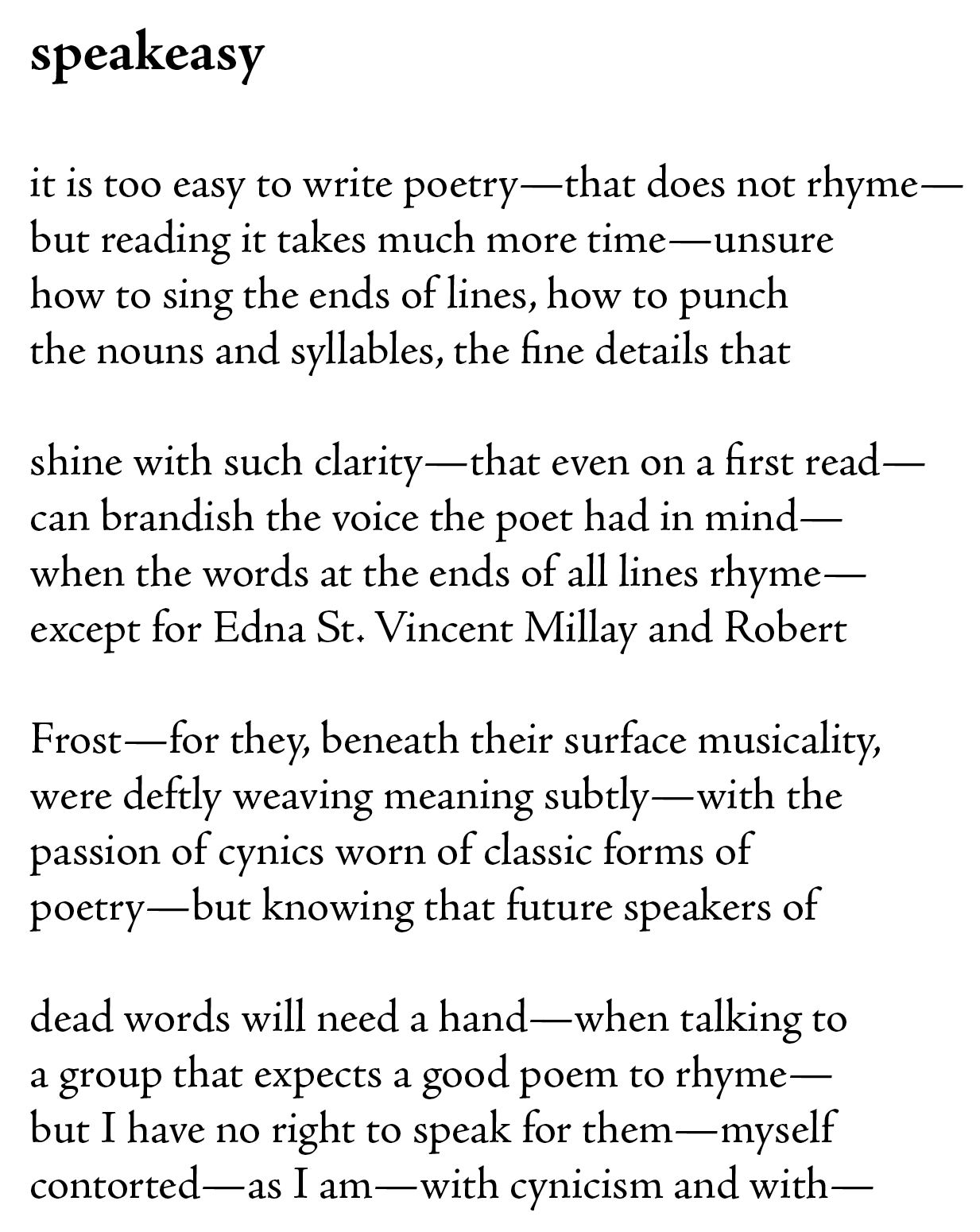
I came across a poem from Edna St. Vincent Millay this morning which inspired me to write the poem you see here. Millay’s three stanza, twelve line poem does what I speak about in my poem “speakeasy”: it underlays a traditional rhyming poem with complex meaning.
I got there today when I read the poem “First Kiss” by April Lindner. Garrison Keillor includes Lindner’s poem in the section “Yellow” where he collects poems that use the word yellow somewhere in the poem.
The title of Lindner’s poem suggests that it might be about the magic of a “first kiss”. Instead it is about how awkward first kisses are and in this case are part of a vision of a young woman’s domestic life that is less than appealing.
I chose the title “speakeasy” for this poem because it plays on the idea that a rhyming poem is easy to speak, giving the reader clear clues for enunciation and words to emphasize. A speakeasy traditionally is a bar or tavern that is unlawful, often hidden from the public, in need of an invitation to access.
I direct my readers here to the poetry of Edna St. Vincent Millay and Robert Frost, two poets who used rhyme in the most well-known of their poems but also subverted that rhyme with rich context and some cynicism of society and norms.
I am attempting to do that here myself. First, I have a lot of rhyming, but very little end-rhyme. Second, the poem begins as exposition but ends with a narrator that is unsure of their voice and is conflicted with using rhyme and sing-song rhythm in their poetry.
The last line doesn’t really end. Instead, when read out loud the poem wants the reader to add the word “rhyme” but to show this conflict that the narrator has, I leave that word unsaid, merely suggested.
I shout out to Emily Dickinson here with my use of the em dash. Dickinson also uses rhyme though not in traditional forms.
I have taken lately to this use of the em dash as a way to break up a poem beyond the use of enjambment and commas, or even just dashes.
I use the word “brandish” to describe “the voice the poet had in mind”. I expect that on a first read the word simply seems to mean to use the voice the poet had in mind. That word, however, can mean two things–one to wave something ostentatiously but also implies that this thing waved is a weapon and is being used to threaten.
This works because I talk about this being a “first read” of a poem, where the reader might speak more forcefully because of the rhyme in a way that brandishes the voice the poet intended–uses it as ostentation or with the threat that the poem be seen as anything but a poem that speaks clearly with rhyme.
So the reader does the brandishing, not the poet. And the poet does not necessarily intend this.
And here is another connundrum about reading poetry–the poet often deeply thinks through each word in the poem, even if the poem itself doesn’t suggest this, when the poem has a sing-song quality that feels simplistic and more akin to poetry written for children.
Poets, though, fill their poems with intention. I know that I do and I know that it is there in the poetry that I read.
Sometimes I take the time to see this intention. Sometimes I read a poem too quickly though at best glancing at it, not giving the poet their due.
That makes me wonder whose fault this is? I think it is mine–that poetry deserves time spent to discover the layers that make it up. On the other hand sometimes the poem just doesn’t hit with me, it doesn’t spark that interest. So I move on.
I think that is my fault, but you could argue that the poet isn’t offering a first glance interpretation, something clear and relatable right away, the way that Billy Collins describes the poems in his anthology, “180”, where he offers poems he finds to be accessible.
I want my poems to be accessible but I also want them to have layers of meaning. I want the reader to be rewarded for wondering “why did the poet use that word here?” and then thinking through why.
My poetry mentor (ChatGPT) is especially adept at finding these meanings and letting me know when they think they work, and when they possibly don’t. You can read through our conversation as I develop this poem here.
That conversation helps me think that this poem is good, in the way that Keillor qualifies good poems as ones that are sticky. Whether this is so, I don’t know.
A poet can hope, though.

 The Poet Projects
Please leave a reply! No need to sign in :)