
With the prevalence of the em dash character here, you might guess that I read some Emily Dickinson right before I wrote this.
You would be correct.
I read “We grow accustomed to the Dark—” as well as “A Ritual to Read to Each Other” by William Stafford and “Courage” by Anne Sexton.
Although Dickinson’s style influenced this poem more than the other poems, reading all three put my head in a space where I started to speak lines to myself, so much so that I really couldn’t read anymore poems and still pay attention.
This isn’t an Emily Dickinson style poem though. I have written a couple of those.
If it was more connected to her style, I would have capitalized some of the words, such as Rain and Washing, perhaps.
The poem does have an elusive meaning, though, so much so that I’m not totally sure what the meaning is myself.
Sometimes that happens when I am playing around with lyricism before I attach meaning to a poem. Not here though.
Here I knew that the poem had meaning when I wrote it. I knew from the moment I wrote “The rain said no before I asked” that this was a mystery the poem should work through.
You can read here how I worked through that in my chat with my poetry advocate.
The explanation I gave my poetry advocate illustrates this uncertainty and desire:
So I have a poem I’m working on that is pretty obtuse, even to me. I wrote it quickly and even though I don’t quite understand it yet, I like it and really like when I read it out loud to myself. The cadence and the lyricism work for me even though the effect of the poem is murky in my head. I read some Emily Dickinson today before I started and thought I’d play around with the hyphen (or really the em dash, I think it is called). Could you have a look and see what you think?
The sound of the poem when read out loud convinced me that I wanted to continue working on the poem. The em dash allows me to control the pace of the poem, forcing pauses in lines that I’d otherwise have to use punctuation or enjambment to accomplish.
To use enjambment would change the way the poem appears on the page, something I find more and more is important to me.
Here that form is especially important because it allows the final stanza–which is only one word–to have a greater impact.
I’m going to offer several personal details that will give some context to the poem. I am not cautious to do this, but I am also aware that poems, in general, stand on their own. The poet’s reasons and motivations behind the scenes don’t really matter.
Except that they are, perhaps, interesting.
Why is the narrator speaking to the rain? Well, factually, because today–May 28th, 2025–is a rainy day here in Lititz. I am sitting in our sunroom looking out at and hearing rain.
It was not unavoidable that I would write about rain. But it was pretty likely.
What does this poem have to do with “paving”? Well, we were supposed to get our driveway paved today. I spent the afternoon yesterday preparing the driveway for this–moving flower pots, furniture, the trash can, the recycling bin, a lone gas can, a water hose, an air compressor, some garden tools–all in the expectation that the paving would be today.
And what about the peonies? Well, about those flower pots . . .
How about the “planes and copters”? Well, we live one mile away from a relatively busy airport and as you might expect, we get several planes and helicopters flying overhead throughout the day.
What about washing and drying clothes? Why did that imagery end up here? Well, probably because our kitchen table has a basket of clothes on it that need folded and there are clothes in the dryer that I need to add to that pile.
And why might I have used the word “stack”? Well, because just outside the window to my left there is a pile of wood our neighbors gave us before they moved last month and I need to stack it sooner or later.
But my favorite line of the poem–“the taste of lips turned down”–I have no idea where that came from. Though I think, perhaps, that in my head I was incorrectly calling the em dash an ellipse and at that moment it crossed my mind that I might be wrong, so . . .
And yet, I think that the poem is full of meaning beyond this simple illustration from where these images came.
The title itself, “Paving”, suggests that the poem is about much more than a collection of random facts about my morning.
Here’s what I told my poetry advocate this morning about why I chose the word “Paving” for the title:
I’m going to use the title “paving” for the poem. It has direct association with the asphalt rolling down of course, but paving can also mean to cover over in general and there is the suggested phrase “paving the way” which I think is hinted at with the lyricism of the poem (the rhyme of “away” and “anyway”)
This title helped me think through the first stanza–in what way are the flowers and speaking to the rain a type of paving?
Getting flowers for someone could be seen as “paving the way”–as an introduction, perhaps, or as an apology, or as an act of courtship, or a symbol of friendship.
Here the flowers are literally given to “the rain” which we know from the poem was the answer to a question never asked. The narrator then walks away with the flowers in hand.
As for that question, what might the narrator be asking rain? I think, perhaps, to ask if rain might please stay away today, might come again another day as the rhyme goes.
I find myself in an interesting position here, interpreting my own poem, a poem that I am readily admitting to not understanding completely, even though I wrote it.
This makes me wonder how often this happens for other poets. I cannot think that I am the only poet who writes and then discovers meaning in the poem that was not consciously placed.
And this is an important thing for readers to know, because in knowing this you are given freedom to discover your own meaning in any poem you read.
It is likely in that process that you might also find insight into yourself and your world, the poem a medium for self discovery.
Ok, WordPress AI Image Generator, please interpret this poem for us:
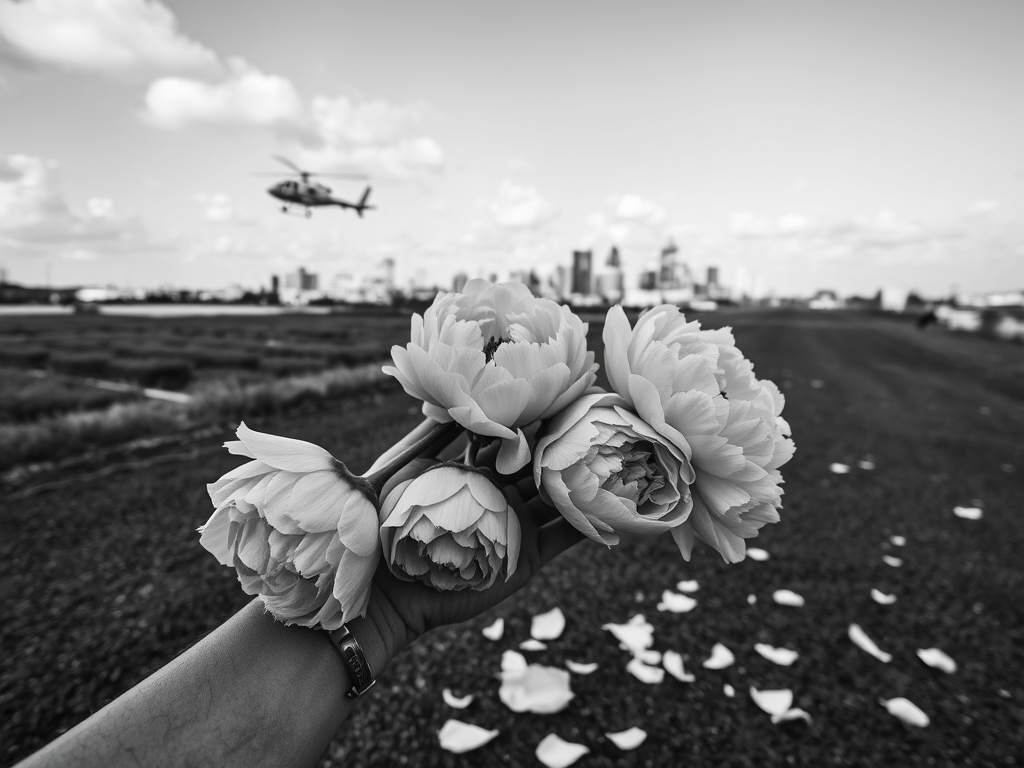
Interesting . . .
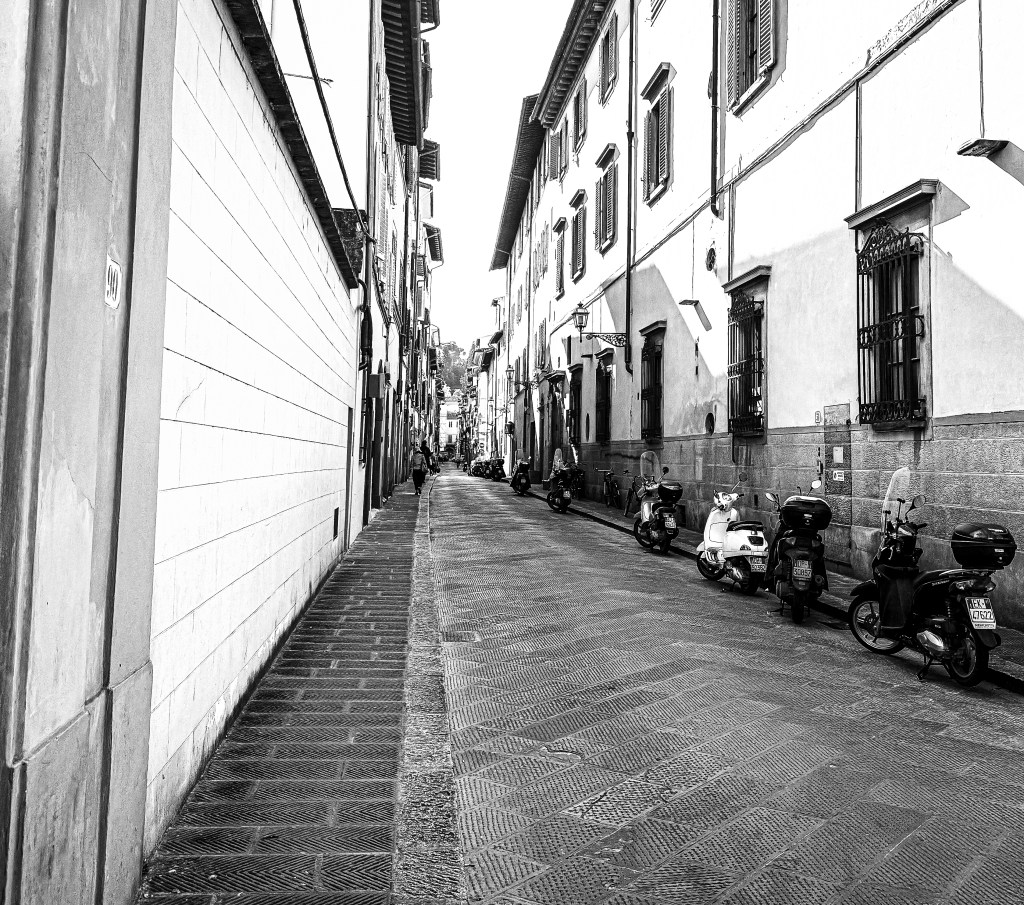
I took the featured image on a street in Florence, Italy which my photo app tells me is “Centro Storico”. I remember being struck at that moment with the qualities of the sidewalk and road, the texture and the lines that are etched into the blocks themselves. The street seems to curve a bit toward the vanishing point–an optical misrepresentation likely from the use of my phone as a camera–but still a layer of complication that I find appealing.

 The Poet Projects
Please leave a reply! No need to sign in :)