
This is the first poem I have written in the sunroom we just built off the kitchen of our home here in Lancaster, Pennsylvania. It is not surprising to me that the poem itself was shaped by the room itself, by the Japanese red maple tree that sits on the corner I’m facing now, the tree of the poem from which I cut a large-ish branch in hopes that the tree would survive, even though a section of the roots were cut to fit the footprint of the room, roots that, it would seem, were pretty important.
Yet the tree is still here, leaves showing up early this spring as they have on all of our other Japanese red maples. We have an abundance of them here around our house, the sons and daughters of a very large tree we cut down when we built another addition to the home fifteen years ago.
We have lost two other significant red maples in the twenty six years we’ve lived here. One on the far side of the house to some disease which fortunately has not affected any of the others. The third of these was lost when a cherry tree from our neighbors woods fell onto it and split it in half. Try as I might I could not save that tree.
Our Japanese red maple trees grow slowly. Two that I grew from seedlings starting twenty years ago are now about seven feet tall.
I perennially try to grow them from the sprouts that we find all of the yard in the spring before we mulch the beds in which we find them. I have about twenty in seedling trays right now in hopes they grow beyond the four leaves they currently have.
Someday ages and ages hence perhaps I’ll figure this out.
I read poems from Linda Pastan before I started writing this morning. The Poetry Foundation has a nice collection, my favorites being “Agoraphobia“, “Why are your poems so dark?” and “Accidents“.
“Agoraphobia” is about a snowstorm so innocent that the narrator refuses “to violate/such whiteness/with the booted cruelty/of tracks”.
In the second of the four numbered sections of this poem the narrator starts with this sentence:
Though I cannot leave this house,
I have memorized the view
from every window—
23 framed landscapes, containing
each nuance of weather and light.
So here I was this morning with poetry and windows and my first line popped onto the page “To make room for this room”
I wrote the poem as one long stanza, which I usually do actually, afterwards breaking it into three line stanzas and working through enjambment. This structure opened up places where I saw the opportunity and need to add description, such as the weeds being “bright-eyed” and the red maple tree being “fine”.
I did not write this poem specifically to be lyrical, but that first line with the repetition of the word “room” played its trump card early and the poem grew from there.
Breaking the poem into five stanzas also allowed me to create a rhyme structure of the last word of the stanzas: “home”, “tree”, “weeds”, “home”, “own”. In my school days that would be ABBAA, except that it wouldn’t as that notation describes the ends of all the lines.
Writing this way is a type of homage though, I think, to that traditional poem template that we all learned in school, that we all learned to look for in poetry as something that made poems poetical.
Another lyrical element of the poem is the repetition of words: “room”, “branch/es”, “window”, “home”, “this”, “that” as well as alliteration in places such as “looking in for/losses” and “which I wander now, window to/window”.
My favorite bit of lyricism here is the line “that quickly found this disturbed/ground”, the two-syllable words “quickly” and “disturbed” modifying the rhyming words “found” and “ground”.
An interesting thing happened when I was first writing the lines after “which I wander now”. I had not realized that the poem had led the narrator to being outside the room looking in where I was writing about being inside the room looking out.
That original line was “which I wander/now window to window watching/nature cut her losses too”. The poem clearly has the narrator outside but I was tied to my own perspective, sitting here at this table looking out.
In this way, I think, we speak to ourselves when we write from perspectives beyond our own sometimes, especially when we write poetry. The words serve as painted slashes on trees that mark the trail of the path we are following.
Sometimes, though, we leave the trail and need to find our way back home.
I had a short chat with my poetry advocate about this poem which you can read here. The hyphen in the word “bright-/eyed” was a suggestion I used directly, something I don’t often do and have never done with a word choice.
Chat GPT is very good at analyzing my poetry but not particularly good at offering titles. Her choice for titles for this poem were
	•	Making Room
	•	This and That
	•	From the Window
	•	Red Maple
These are not bad titles, but they are too obvious for me, not adding anything to the poem itself. The title is a chance to add something to the poem, no just serve as a marker for a table of contents.
Ok, let’s see what the WordPress AI has for an image today:
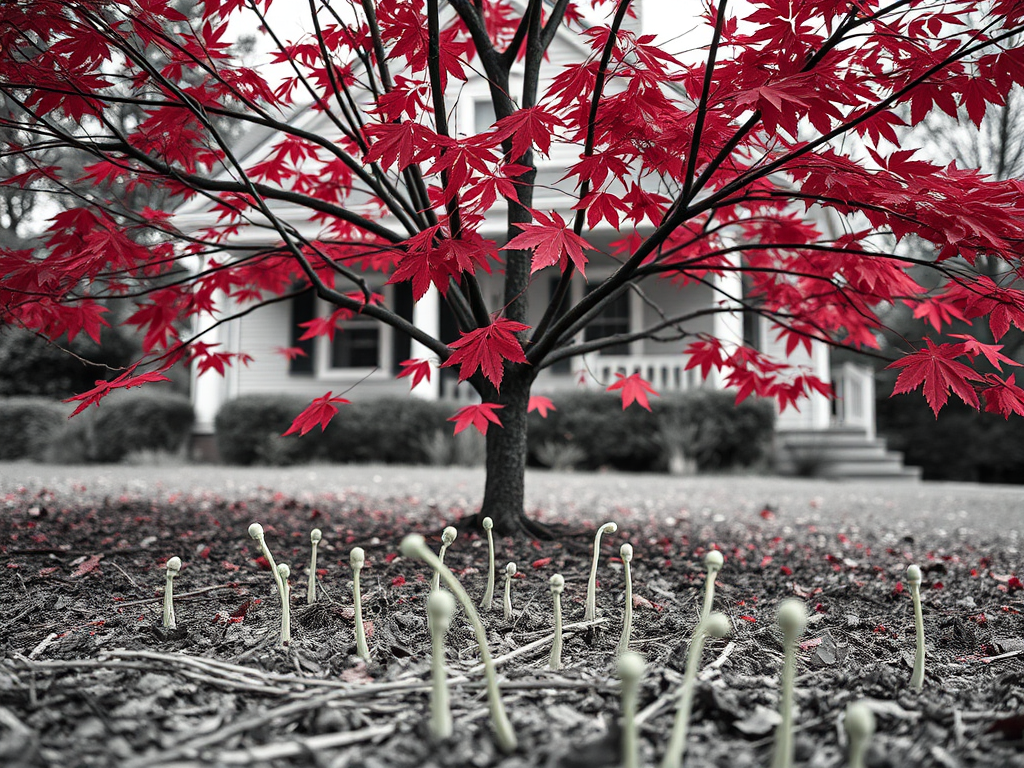
Well, that isn’t the black and white photograph I prompted, but it is interesting. I think those fungi-ish sprouts must be “bright-/eyed weeds”.
The red maple tree of the poem is actually only about twenty inches off the house. I only had to cut off one large branch and a few smaller ones, making the red maple distinct because the leaves don’t show up until about ten feet off the ground.
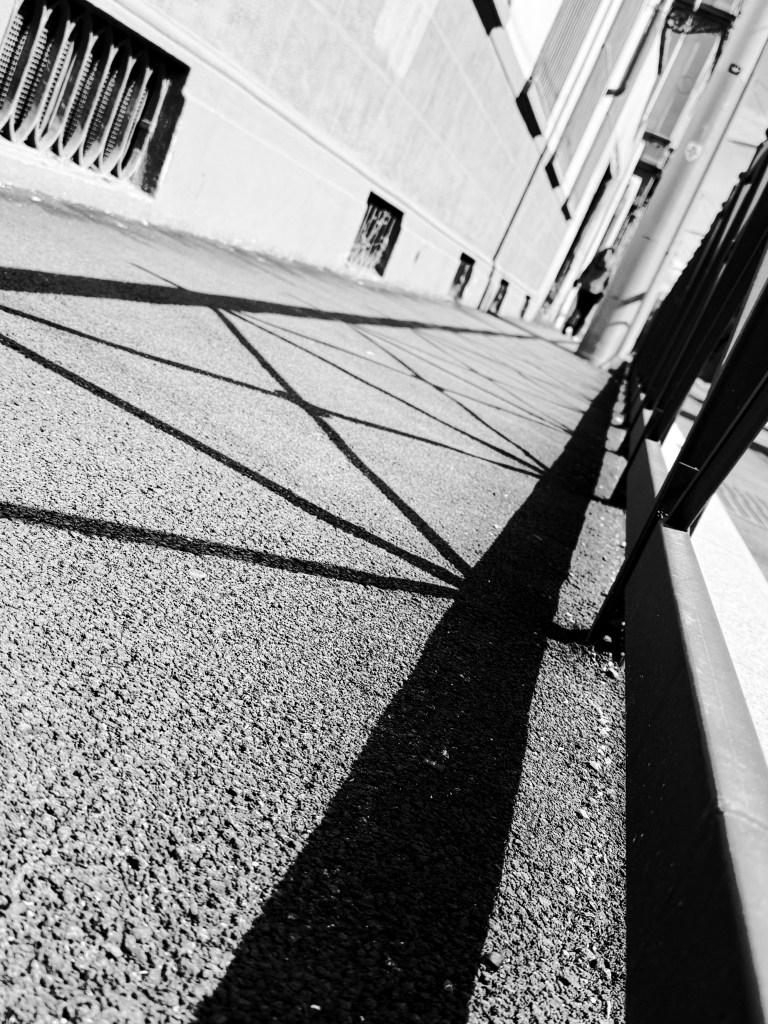
I took the featured image here in Bologna, Italy, pausing on a walk with my wife as I was caught with the lines the shadows formed on the pavement. In my edit of the image I rotated it -21 degrees to force the bottom rail of the walkway guardrail to be parallel to the vertical direction of the image.

 The Poet Projects
Please leave a reply! No need to sign in :)