
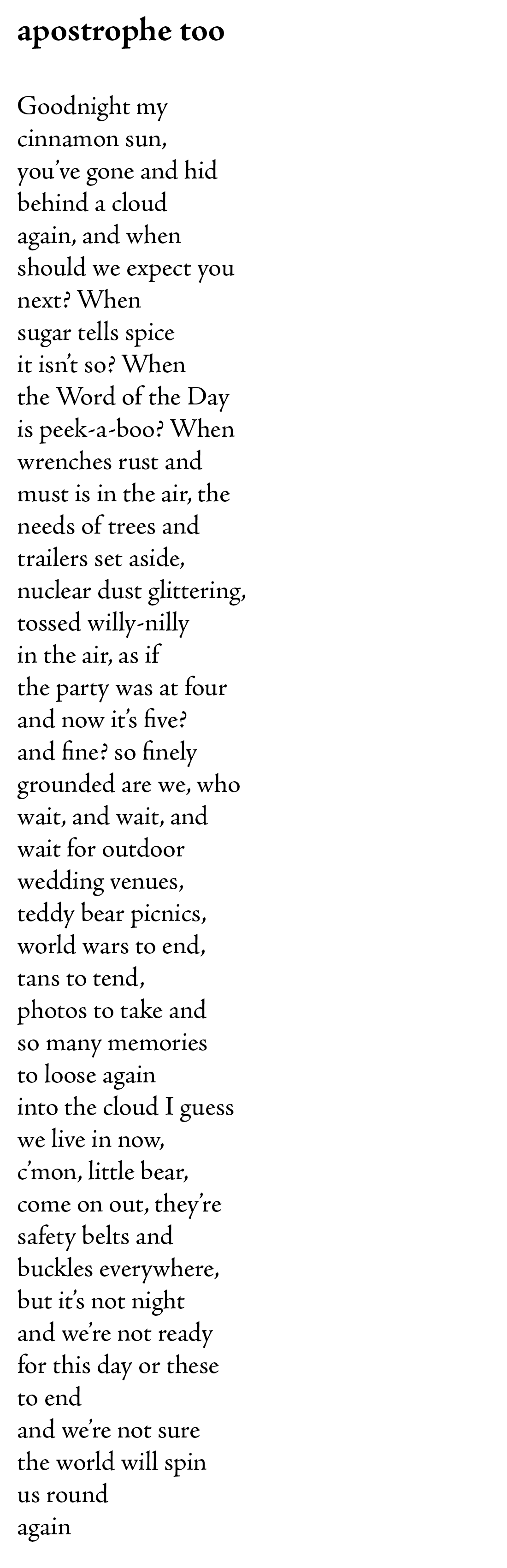
This poem, as the past few, was a “burst”, a rapidly written poem in response to reading poetry from one or several poets. In this case I was reading the poetry of Angie Estes.
Three of her poems prepared me to write this one–“Apostrophe“, “Gloss“, and “Rhapsody“.
This is not to say that I have copied Estes’s style or even approached her rich and tightly written poetry.
In fact, when I write like this, I am simply listening to the poetry I read and letting it resonate in my head.
Also in my head was the humor of George Lewis who you can see here in this Instagram post.
The word “cinnamon” was lifted directly from “Apostrophe” and refers to a cardinal calling to his “cinnamon mate”.
Hearing the word and admiring what Estes does there in that poem, speaking at once about a Cardinal in the church and a cardinal in a backyard, I wanted to use it. I had just finished watching Lewis’s “two toddlers chatting” gem and lifting the idea of the sun playing peek-a-boo, and bob’s your uncle.
So there I was with the first lines of the poem, “Goodnight my cinnamon sun, you’ve done and hid behind a cloud again” and I realized that the sun here was the parent and the speaker was the child. The sun was playing “peek-a-boo” behind a cloud.
Keeping this in mind, I tried to work in references to childhood–“teddy bear picnics”, “safety belts and buckles”, “little bear”, the word “everywhere” (a subtle reference to the book Goodnight, Moon) and at the end being spun around as when a parent spins their child around.
But I also wanted the “child” to be aware of the uncertainties of life, of the possibility of war, of things rusting (a parallel to cinnamon with its red and sometimes being dust or powder), of the need to grow up (tanning), and of the maturity to know that even if something is covered up it is probably still there.
My AI mentor said that you could say this poem was “playing peek-a-boo with certainty itself”. I really can’t get over the power of AI to act as a sounding board for my ideas and drafts.
And a quick note about the word “apostrophe”. This has multiple meanings, but the one that you might miss was using an apostrophe in the word “c’mon” near the end of the poem, meaning of course “come on” but also this is a shortening of the word “cinnamon”.
I want to jump back to the “subtle reference” I mentioned to the book, Goodnight, Moon. This is the second poem of mine to allude to the book, the other time being my poem “night-night“. Aside from the word “everywhere”, the other clue–as if this poem is a mystery to be solved–is the first two lines, “Goodnight my cinnamon sun”. Not moon here, but the allusion, I think, stands out once you see it, replacing moon with sun.
My question here is, does it matter if my reader doesn’t catch this? I say no. It doesn’t matter.
What matters for me, though, is that the poem has layers of meaning, that upon further study a reader can continue to find meaning.
So, some times in the poem where I tried to structure additional meaning:
- I took the idea of cinnamon being (usually) in powdered form and use the powder-esque words “glittering”, “dust”, “fine”, “finely grounded” to strengthen and broaden that idea that solid things can be turned into powder, that things are made of smaller things, that this process at some level is destructive
- I use the idea that things rust as a reference to cinnamon again (the color as well as the type of rust that comes off on your fingers when you try to use a rusty tool) but also to offer that rusting is as also a destructive process
- The line “sugar tells spice” again is a continuation of the theme of cinnamon, here speaking dually about the child’s treat cinnamon and sugar as well as the more adult world where things and life can be spicy. The phrase is also part of a well-known children’s rhyme, “sugar and spice and everything nice” for “what are little girls made of?” In the poem, sugar is telling spice when the sun will come out again, i.e. when girls are no longer made out of sugar and spice, when girls (and by extension all children) grow up.
- The line “when wrenches rust/and must is in the air” is a shift in the poem to one where things start to decay, where time eventually wears all things down to the point that they rust or become musty. I am using the word “must” though because there is another sign of growing up, when there are certain things that one must do.
- The line about “nuclear dust glittering” is speaking two-fold, both about the idea of there being smaller elements of all things (nuclear–the powder/dust idea I mentioned above) but also about the dangers of the future, of a possible world war and/or a nuclear war and nuclear winter which would also block out the light of the sun with a type of glittering cloud. The end of the poem where I mention “we’re not ready/for this day or these/to end” is tying that idea down, the chance that the world as we know it will end when the sun disappears for good (these) but also we don’t want this specific day to end, or to say we don’t necessarily want to grow up (this).
- The photos and memories that we “loose again/into the cloud I guess/we live in now” is drawing a connection between the clouds that block the sun and the digital cloud that we are more and more making a permanent part of our lives and that we are waiting to do, as we wait for “tans to tend” (growing up and basking in the sun when it comes back), “world wars to end” (for war–a very adult thing–to stop or for a world war to end the world itself)
So I’m a bit torn about saying I did these things intentionally. That implies that I put these layers in the poem consciously. Yes, I guess I did, in a way, and I certainly take credit for them. And if I had edited the poem to strengthen the ideas, which I didn’t, then yes, I could say “I did this” or “I did that” with more confidence.
But this poem was a burst, as my last few have been. I spoke recently about feeling like I was trying too hard with my poems, going back into them and making sure that layers were there, that I crafted the poem over time and carefully tightened the poem’s meaning. My poem “spilling” was this type.
And I like that poem. But it was no burst. It took me time to get it where it is.
But this poem, I wrote so quickly it’s hard for me to say that I crafted the poem. As I wrote, though, I knew these layers were there and I saw them and recognized them. But when I finished I noticed more than I was aware of at the time I wrote. The Goodnight, Moon allusions, I see those now as clear as day, so to speak. But that wasn’t done in a way that I said to myself, “Oh! I want to draw an allusion to Margaret Wise Brown since I’m talking about childhood.”
As I write these post-poem blog posts I am struck by how much I want to hear Robert Frost talk about writing one of his poems or Wordsworth or Yeats or Angie Estes or Heather McHugh.
Not to say I’m in league with them. But I’m in a league, at least.
Now let’s see what our AI image generator has to say in its “thousand words” about this poem:
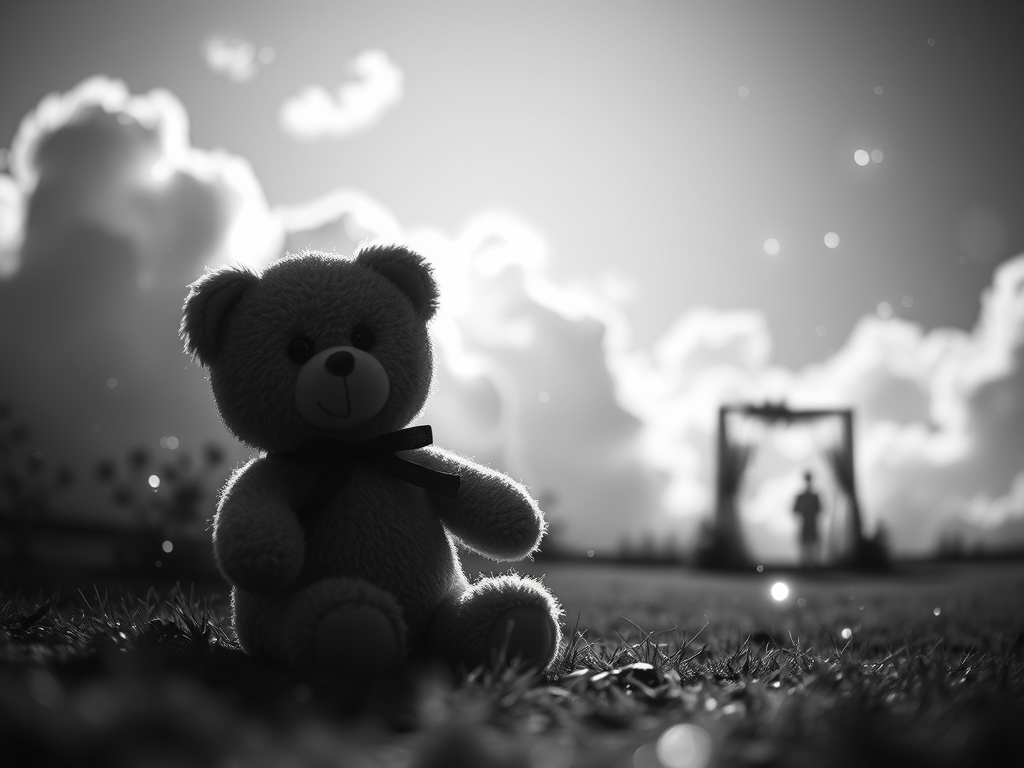
Wowsers!
The featured image here is the shadow of a Moravian Star that hangs in one of our windows that faces east. It clearly wasn’t a cloudy day when I took the photo. The images I choose really aren’t related necessarily to the poem. Here perhaps because the sun is involved. Otherwise, not so much.
 The Poet Projects
Please leave a reply! No need to sign in :)