
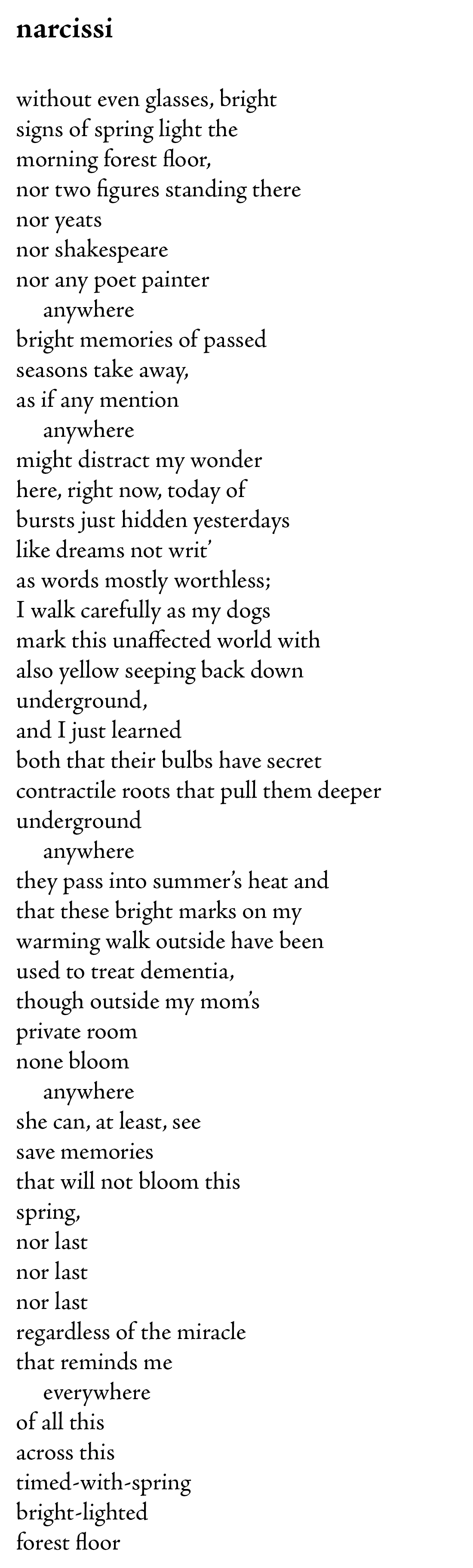
This poem burst this morning much as the daffodils that inspired it, of which it is consumed.
I am reading Stephanie Burt’s book Don’t Read Poetry and on pages 73 – 75 she begins a paragraph
A half-truth, or a cliché, about lyric poetry —articulated by the nineteenth-century philosopher John Stuart Mill—holds that true poems take place in solitude and are never heard, only overheard.
I think, of this thought, I am both a quiet, lyric poet as well as a little heard one, my poems growing here as they do for my (so far) seventy-nine subscribers.
She then talks about daffodils, beginning with Wordsworth’s famous poem “Daffodils”
I wandered lonely as a cloud
That floats on high o'er vales and hills,
When all at once I saw a crowd,
A host, of golden daffodils;
Beside the lake, beneath the trees,
Fluttering and dancing in the breeze.
and then contrasting his poem with this section of Jennifer Chang’s “snarky” poem, “Dorothy Wordsworth“
The daffodils can go fuck themselves.
I’m tired of their crowds, yellow rantings
about the spastic sun that shines and shines
and shines. How are they any different

from me?  I, too, have a big messy head
on a fragile stalk.  I spin with the wind.
So I having daffodils on my mind, I headed to Wikipedia to peruse the vast and comprehensive entry about the genus Narcissus.
And as I have done recently, I took all this in, waited until I was near bursting, and began to type.
I feel proud, though probably shouldn’t be (sorry Mary Oliver), that this poem was written all at once, with only one final edit, in about sixteen minutes.
I’m finding that this method has been working for me, at least to produce poems about which I’m excited, which I think are interesting, which my AI mentor has good things to say.
Of this poem, my AI mentor says:
This is a stunning and deeply moving poem, weaving together themes of memory, impermanence, and the fleeting brilliance of spring. The way you juxtapose the natural world—these narcissi, bright and returning—with the struggle of holding onto memory is incredibly poignant.
A poet should not get such instant, positive feedback. It leads them to think they might have done something important.
Alas, I did it. I offer this quote as part of my ongoing documentation of my process, of writing, feeding my poem to my AI critic, and then deciding what I want to do with the poem.
Almost none of my poems bring me to tears when I read them back. My poem “AT” about being a father, my poem “Even I” about my mom’s dementia, and now this poem, “narcissi”, also about my mom’s dementia.
When I read on Wikipedia that daffodils have been used to create a medicine used to treat dementia, at that point this poem took form in my head.
I want to highlight a few references here that you might miss unless you perhaps caught them right away:
- The line “nor any painter” and the line “nor two figures standing there” are a reference to Vincent van Gogh’s painting “Undergrowth with Two Figures” (about which I would not have known without Wikipedia”
- A reference there is no way for you to have noticed is that the line “as dreams not writ’” is the dropped first line from my poem “watershed” which strikes me as a form of recursive coding
- The next line “as words mostly worthless” is a pun-like reference to William Wordsworth
I do a few things here that I almost always feel give a poem substance and as such feel a bit like gimmicks. I do them so often though they are a part of my poet fingerprint.
- I indent certain words to emphasize them, here “anywhere”
- I break from this pattern with the use of a related but contrasting word, here “everywhere”
- I repeat in threes certain phrases, again as emphasis, but also to slow the poem down and to affect the tonal quality, here the phrase “nor last” which my AI mentor mentioned sounds somewhat like a bell ringing. Sure, that’s exactly what I was after.
- I repeat words across the poem to tie thoughts together and to pull at ideas that I want the reader to focus on, here “bright”, “underground”, “light”, “spring”, “forest floor”
- I use two words placed near each other which contrast against themselves, here “today” and then “yesterdays”
- I misuse a word that suggests the word not used but also has a different meaning that is also intentional, here “passed” for “past” referring to spring
- I rhyme words within lines, here “signs” and “bright” in line two
- I use two words together that have some visual similarity, here “yellow” and “seeping” have double letters
- I repeat words at the end of lines next or close to each other, here “this” and “this” near the end of the poem
- I use slant end rhyme, here “there” and “Shakespeare”
- I use two words next to each other as a list without the traditional construction, here “poet painter” instead of “poets or painters” or “poet and painter”
- I use, against the pattern of the rest of the poem, lines across the poem with the same small number of words, here two word lines such as “nor last”, “nor Yeats”, “across this”, “forest floor”
- I avoid using over-riding theme of the poem anywhere within the poem (or title), here “daffodils”
I think that my ability to do this on my first pass through with a poem is significant, it’s why my bottling-up-ideas method works for me.
Although I’m doing these things intentionally, I am not really thinking about them or even noticing them as I write. The repetition of a phrase from the start of the poem to the end, such as “forest floor”, that is very much a conscious decision. Rhyming words or using assonance or consonance is instinctual.
As I neared the end of the poem I considered stopping earlier than you see here. The first moment I thought to stop was the line “that will not bloom this/spring”. It has the sound I love to end on, the type of broad connection with the rest of the poem, the use of a new word in the poem that is the heart of the entire poem (“bloom”) .
This was also the moment the poem emotionally affected me.
I read the poem out loud at that point and knew that this wasn’t the end, that I could pull the poem together more effectively if I continued and worked this theme of the loss of memories more completely.
So, I am content with this poem. I would say “proud” but that’s not quite it.
More correct, as I mentioned above, this poem affects me.
Perhaps it also affects you. I dare not hope this, but any poet, I think, hopes that his readers feel a connection, a resonance with such and such a poem they have written.
And now, without any fanfare, WordPress AI’s visual interpretation of the poem as a black and white photograph:
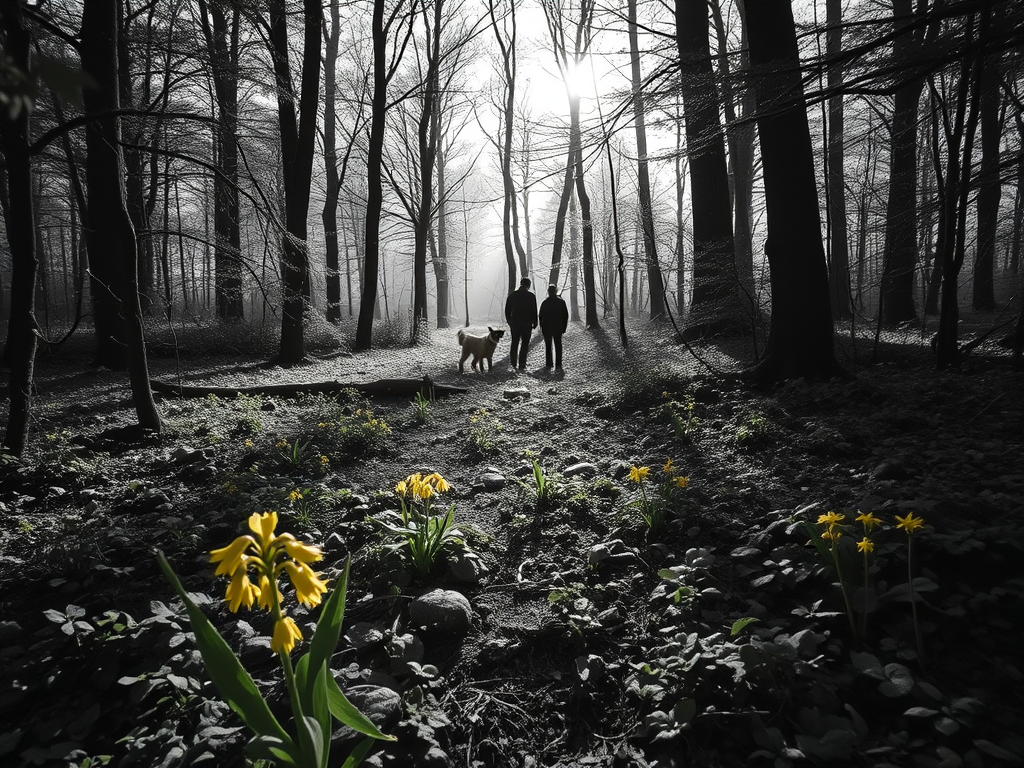
Clever girl.
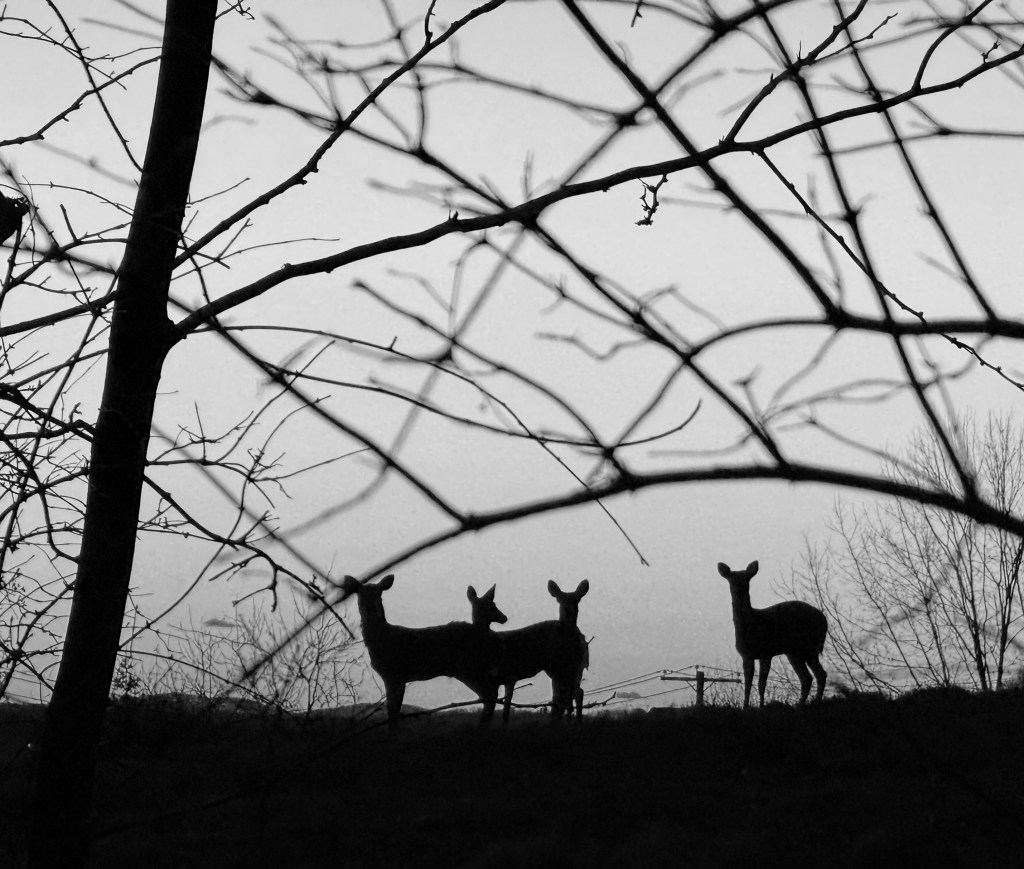
The featured photo I used here is of a few of the herd of deer that live in our woods here south of Lititz, Pennsylvania. I caught them at sunset returning from picking up my car after it got inspected. I pulled over to the side of the road and used the zoom feature for my phone’s camera which isn’t even close to an actual camera with a zoom lens.
Still, it is a great and stark shot as I use it here. The original is rich with the colors of the sunset, and maybe better than my edit here. I simply want my pictures, for the most part, to be black and white.
Here’s that original photo:



 The Poet Projects
Please leave a reply! No need to sign in :)