
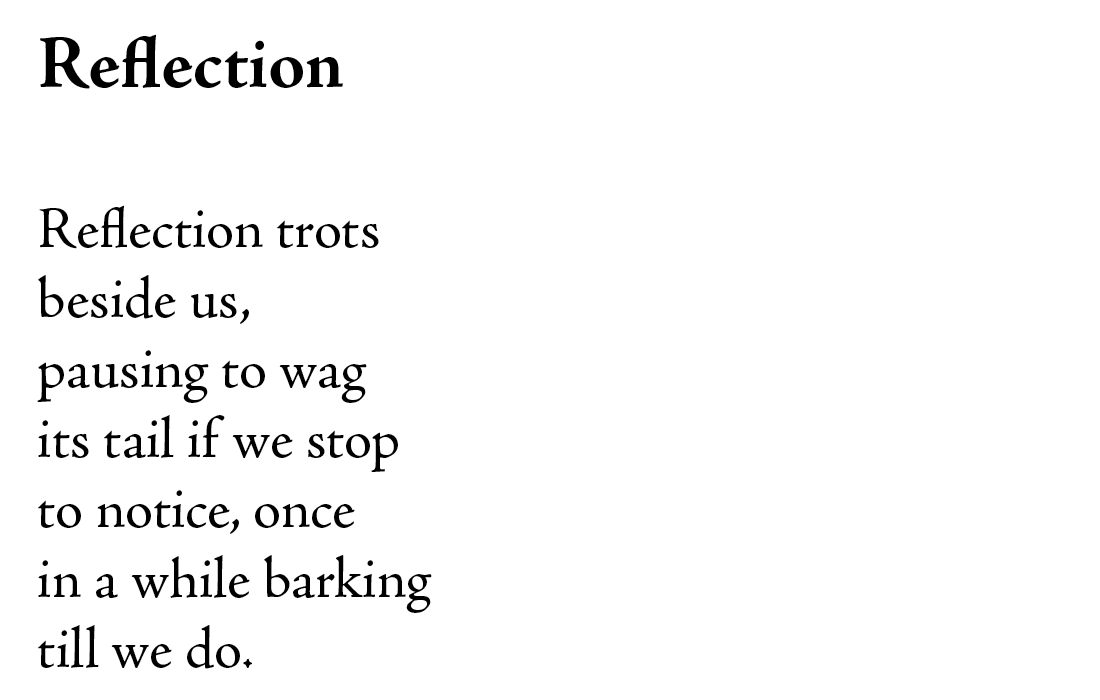
I wrote and posted this poem a year ago, remembering it today for two reasons. First because it is short and clear, in the style of the poems I’ve posted this week. Second because its title sounds a lot like “respection”, the title of the poem I wrote and posted a couple days ago.
This was the second poem that I wrote commentary on, the second time I attempted to document what I was thinking when I wrote the poem and to talk about the things I was trying to do with the poem itself.
I have titled the posts that use this process “Vacillating Crudities”. This is the explanation I originally gave about where this title came from:
The poems I create for this long-term project of mine–The Poet Projects–are meant to be created at one sitting, edited as needed for the moment, and then posted. As such I consider all of them drafts. Poems, above all writing, never quite feel finished for me. I am stuck on Poe’s thought from his essay “The Philosophy of Composition” that every word must be chosen with “precision”.
He doesn’t exactly say “should”, but in explaining how he wrote “The Raven”, Poe explains that the “work proceeded step by step to its completion, with the precision and rigid consequence of a mathematical problem”. So, at least in this one case, he is suggesting he did it himself.
I’m not sure that he isn’t speaking sarcastically about his own work or perhaps not telling the truth about how he wrote the poem.
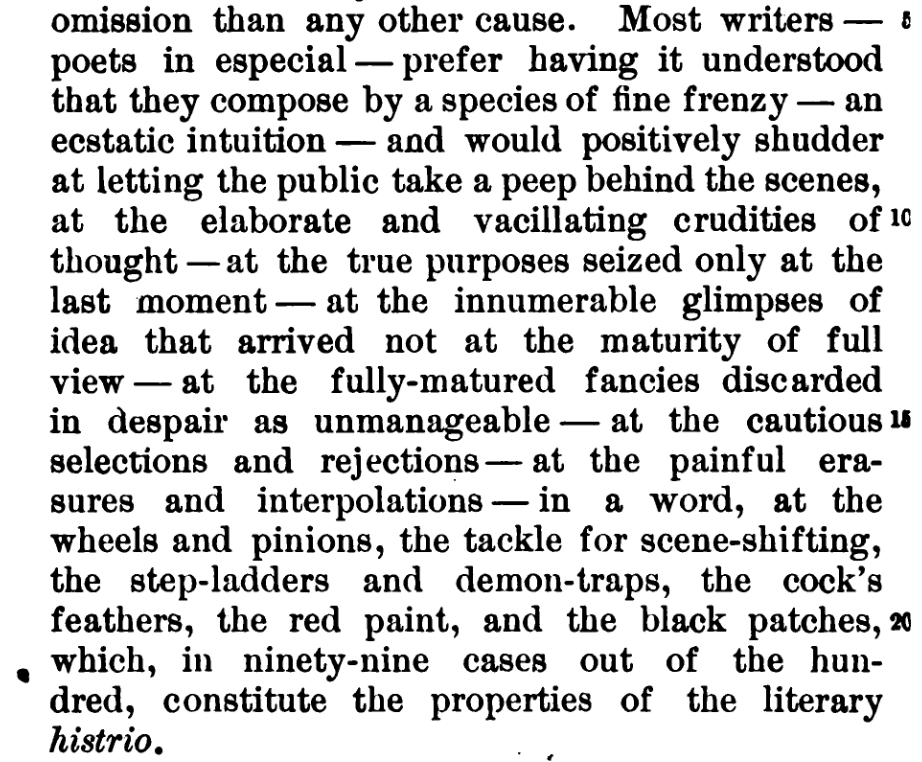
I noticed as I read his essay just now that this commentary I’m giving, about how I wrote my poem, is something (as Poe says) most writers “would positively shudder at the thought” of doing, letting “the public take a peep behind the scenes” of how I wrote it.
I’m pulling this phrase from Poe’s essay–”vacillating crudities”–as the title for this part of my website, this part where I comment on the poetry I am writing, trying to explain the process and thoughts behind each poem, as Poe says, “the wheels and pinions — the tackle for scene-shifting — the step-ladders and demon-traps — the cock’s feathers, the red paint and the black patches, which, in ninety-nine cases out of the hundred, constitute the properties of the literary histrio”. Quite apt.
A year later I really like this poem. It is simple. It is clear. The metaphor is very direct.
I took the time with this poem to go back through the history of the document and take screen shots of the versions of the poems changing up until the end, turning those into an animated gif.

I had thought I’d do this more, but it was time consuming. And as interesting as it is, I don’t think it deserves to be done very often for me.
Here is my original commentary on how I wrote the poem:
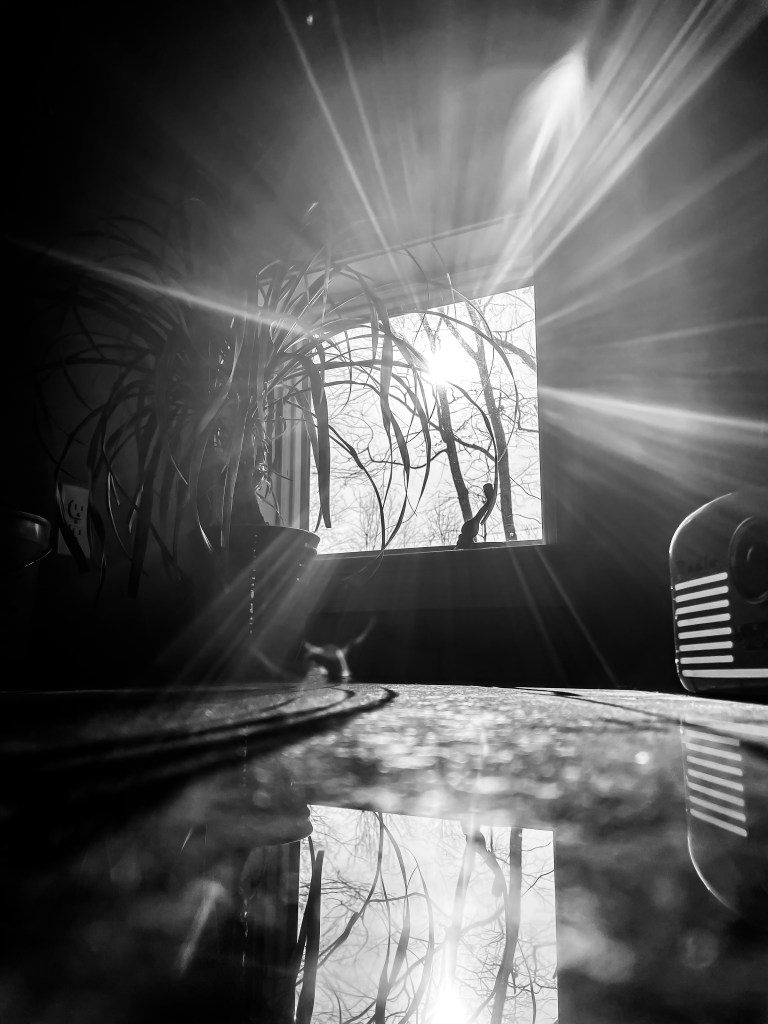
“Reflection” came quickly to me. I was coming up from our garage having just taken the dogs out and I noticed that the sun was coming through a small window in our foyer in a way I had not noticed before.
My camera/phone in my pocket, I took a few pictures from various angles. We have a granite countertop there and the reflection of the window on the surface was so bright and clear, despite the granite being dark and speckled.
I had the newspaper in my hand and I didn’t even bother to set it down, fearing that the moment would pass. So, I fumbled a bit to take the photo with only one hand. When I want to capture a shot that low to a surface I usually turn my phone upside down so that the lens is closer to the surface.
I took a couple of shots and then realized that there was a gallon bucket sitting on the counter that I left there to remind me to water the plant that is also in the picture.
I pushed the bucket out of the way with the newspaper but it is still there on the right. You can just see the handle glinting.
I thought about using AI to take the bucket out, or cropping the photo more, but I don’t like using AI (for me, Photoshop) to strip things out of a photo. It isn’t that important to remove it and there is so much to be lost in that process. As for cropping the bucket out, I tried but couldn’t make it work for me.
The burst of sunlight around the window in this photo really pops, especially in the black and white world of my photography. My photo editing is done almost entirely in Adobe Lightroom. I have created about twelve filters that I run each photo through, usually noticing something I like in at least one of them. If those don’t catch me, I go through LR’s basic b/w filters.
Once I find something that catches my eye I run through some basic levels–black, white, contrast, exposure, shadows–adjusting each one to see how they affect the image. Here, as I don’t trust my critical skill much regarding photos, I just turn my brain off and wait to see what looks best to me.
This poem came from the photo, from the reflection on the granite affecting me in a surprising way, and the instant parallel I saw in physical versus mental reflections.
Poems start in my mind, not on paper, and in this case I sifted through various first lines quickly and without too much thought, similar to how I adjust sliders for photos. I play with words, listening until something catches my ear. Then I put the words on paper before I forget them.
In this case these were my first lines:
A reflection glances
at all surfaces
and across some
lifts its tail to wag
and then marks
At that moment I was already thinking of casting reflection as a dog. Having just been outside with my own dogs, and having watched them so many times sniff a spot and pee on it, this isn’t a surprise to me.
From there I played around with the idea of reflection being a dog, toying with other things that dogs do, how they react to us when we give them attention, how they behave when we are not paying attention.
This poem was always going to be short, mainly because I had a short window of time to write and I knew that I wanted to post a poem. In this case, having access to version history, I can see that it took me eight minutes to write the poem once I created a document, so probably ten minutes or so with sorting words in my head.
Looking too closely at the creative process can be misleading, I think. This is how this poem came to be, but this isn’t how all of my poems are created. Much like looking closely at anything, when you zoom in you can lose perspective of the whole, the forest for the trees if you will.
Two days later I can say I am smitten with this one, especially the combination of the poem and the image. They complement each other at a very obvious level, perhaps too obvious, but also they can be taken in quickly and each offers the chance for a bit more in-depth study if the reader has time to pause for …
Well, I won’t say it. Even putting three dots down there seems obnoxious. Vacillating crudities indeed.
 The Poet Projects
Please leave a reply! No need to sign in :)