
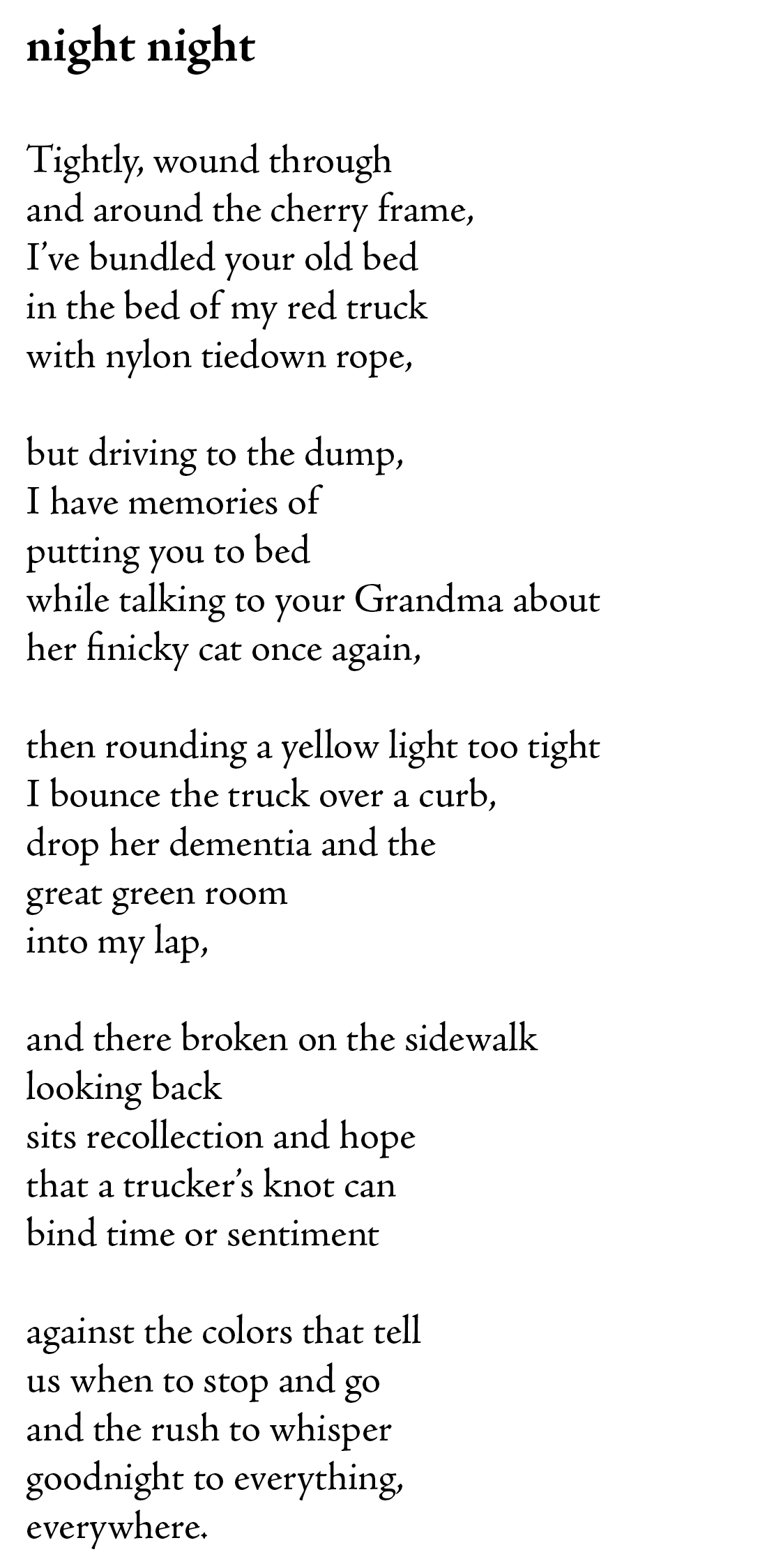
I began writing this morning thinking more about sound than content, the first few lines originally reading,
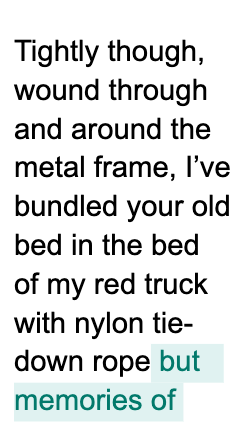
The lines were short and I played with the “ou” sound. I eventually dropped the second word, “though”, as it lost its function in the context of the poem. As much as I loved the look and sound of it, it had to go.
Funny that this is the theme of the poem, letting go of things to which you’ve made an attachment. In this case, it is a child’s bed that the narrator is taking to the dump.
I use the word “narrator” because I want to draw a distinction between this poem/my poems and myself. This story did not actually happen. This poem is not memoir.
On the other hand, such sentiment is rampant in my life. We do have two cherry single beds that originally fit together to form a bunk bed. It is possible that I read the book “Goodnight, Moon” to one or all of our children while they were in this bed going to sleep.
It’s doubtful though. We did read “Goodnight, Moon” to them, but when they were very young, not at the point they were sleeping alone in a bed, I don’t think.
The book though fits the narrative and it came to me after some revision that it could carry a lot of water for the poem.
Color is important for Margaret Wise Brown’s book as it is for this poem. The color yellow is not one of the words in her book, but the board book is rich with it as well as red and green, which are mentioned directly, the great green room and the red balloon.
For the poem, I used a yellow light as the turn of the truck and the turn of the poem from concrete description to imagery, dropping things that cannot be dropped into the narrator’s lap, things falling out of the truck that can’t fall out.
I am cautious here to suggest that this intention was originally in my mind, that I knew ahead of time that I wanted to move from real to abstract, that I wanted this to happen with an event that was both real and metaphorical.
That is what is here in the poem, but the intention happened with revision. It happened when I noticed it was already happening and I ran with it.
The poem originally ended with the line, “that a trucker’s knot can bind time” and at that point it felt finished.
I was workshopping the poem with Chat GPT as I have been, though, and though I had positive feedback, I have learned that I need to ask explicit questions. Chat GPT is a kind critic and simply asks if I think I’m happy with such and such a thing.
I asked whether it was clear that the narrator had dropped a phone into her lap, then having that part of the poem reading,
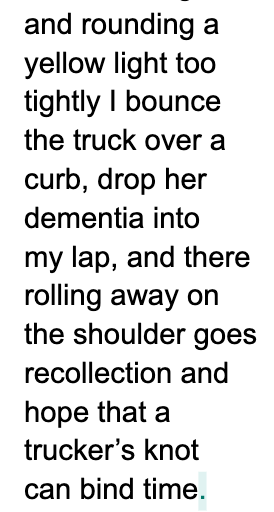
The answer was no, it wasn’t clear.
That’s when I thought about a way to suggest that there was sentiment attached to taking this bed to the dump. At first I had the line, “drop her dementia and goodnight noises everywhere in my lap”.
But then I realized that “Goodnight, Moon” is a book about not just sounds, but colors. I was already using the color yellow with the light. Why not the two distinct colors from the book, green and red?
The bounce is clear, I think–link the colors of the poem to the book. Link the sentimentalism of the book to the poem. That gives me a path to expand the layers of the poem from a simple narrative to a more complex structure.
The colors in the book happen to match the colors of a stoplight. The stoplight being yellow, or between the two colors green and red, stop and go, causing this run over the curb, causing the phone drop which is the remembrance of the narrator’s mom’s dementia and the recollection of reading the book to her child.
The tightness of the rope, something important to keep the bed from moving around in the truck ride, cannot hold back emotions and the loss of memory, the saying of “goodbye” and “goodnight” to things.
Interpreting my own poem isn’t really what I want to do here. Talking about the process is.
Which also includes the feeling of contentment I get when I finish a poem of which I am proud to say, “I did that”.
This poem had a few moments of flow, moments where I had these insights and had enough time and energy to follow them.
This isn’t to say the poem is done or feels totally done. It feels in the condition that it is ok to share. Probably there are only punctuation marks to change.
This process I’m exploring here, talking about my own poetry, how I wrote it, what I think it means, analyzing it with some pretense of objectivity has its roots in the essay, “A Philosophy of Composition” by Edgar Allan Poe in which he talks about the act of composing “The Raven”.
At the top of this page I’ve set a link to the original posts I made where I was developing this idea of looking at my own process of writing.
Now, every poem is accompanied by such thoughts. It has become my format as much as my style. I think perhaps others are writing this way and posting their poems, but I have not found them yet.
I am now planning a book based on this format, which I have mentioned before. I am also considering moving to a Patreon format where I will continue to post the poems but reserve this response to my poems for my patrons, as they are called, I think.
It would be a bold move on my part, for me to put forth my work and thoughts as something worthy of coin.
I am encouraged to push my boundaries in reading Austin Kleon’s book, “Show Your Work!”
I began this poetry blog, in fact, using his writing as my inspiration. I am approaching two years now and I’m ready to take the next step.
More on this to come.
Let’s see what the AI has for an image based on this poem:

There you go! Nailed it?
I took the main post photo again at the SAAM in Washington, D.C. I am unsure about rights to use photos based upon the artwork of someone else. I know who I can ask though!
Hey, Chat GPT, what does copyright law have to say about me taking indirect pictures of artwork from a museum and using them in my blog? I am I in violation in any way?
It says I cannot use the image in the way I’d like, i.e. here on this page, in a blog that is about to become a commercial venture.
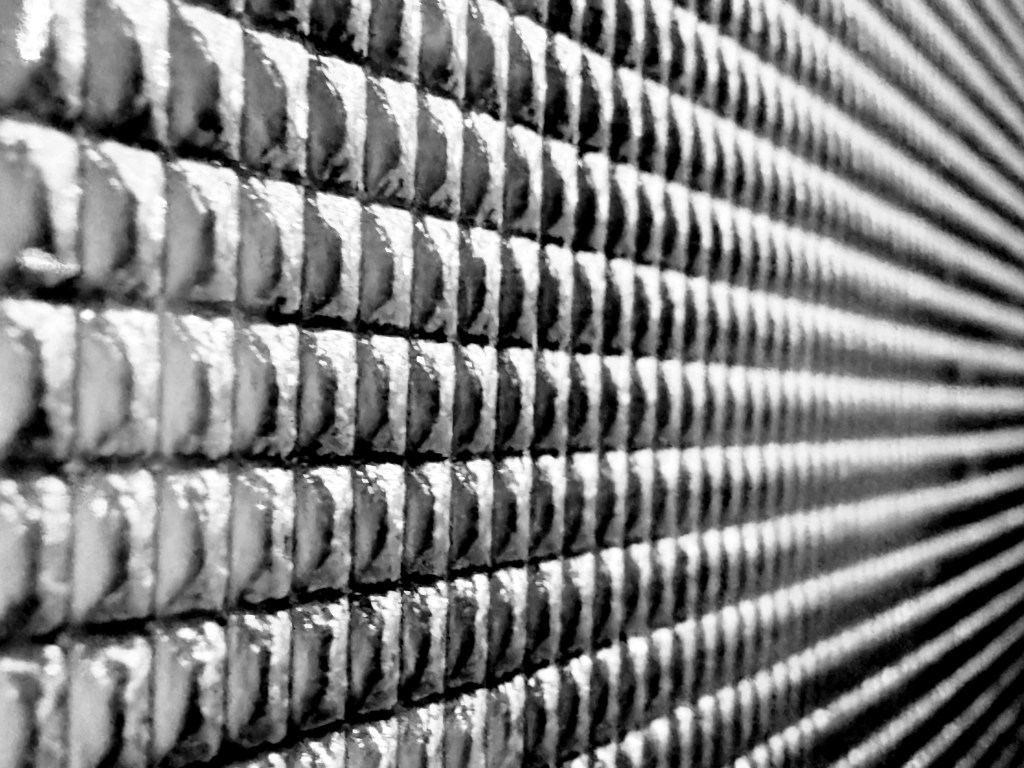
So, that image is replaced with the one you see here, taken of a wall, somewhere in D.C.
Such is the cost of asking about copyright law.

 The Poet Projects
Please leave a reply! No need to sign in :)