

I am two blocks from the U.S. Capitol Building, a majestic spot. Yesterday morning I took my phone with me, which I usually don’t do. It was a cold and foggy day, and I snapped this picture of the Capitol Building.
I got a lucky with the weather and a bit lucky with the shot, quickly framing it, taking only one picture, my hands already frozen.
It was a good shot in color and then when I did some editing and brought it to black and white, which I do for all my pictures, it popped.
I want to say that I really don’t know much about photography. And also, of course we all know this, it is much easier to take good photographs in our digital age, where the camera and computer it is attached to are doing so much work in the background.
Still, this is a very good shot. I my humble opinion, it is better than the Capitol Building wall art that is in my room.
And now the poem. I wrote this minutes after “fabrication” in the Lancaster Public Library in my Fieldnotes notebook, tight and cramped on the last free page that was open.
I had seen homeless men on the street walking in. Some of the people sitting in the seats in the library were likely homeless.
This poem isn’t an attempt to work through this overwhelming problem that our society faces and ignores. It is an attempt to talk about the emotional reaction that I had seeing them that cold afternoon.
The use of the name Peter happened because Peter was the name in a Robert Hass poem from a book I had pulled from the shelf. Alas, I did not keep track of the page number or the title of the poem or even the book.
I am not sure why I kept the name. It is not significant, except that it is not mine and it is part of the notion that Peter does not exist. That I am speaking about myself, but in a way that I recognize is not really me.
The story about the sleeping bag and camping out in the woods behind my house are both true, as much as I remember them now over fifty some years later.
I was, as a kid, and even sometimes still as an adult, prone to homesickness. As a kid it was brutal. I still remember the pain. I can resurrect it sometimes using the couple of things I still own from then, holding them in my hands, thinking about getting rid of them.
That second grade year was the worst. We only lived there in Lucas, Ohio for one year, on a small eight acre farm, a place that I loved–hills, woods, a black raspberry patch, two horses, a barn, chickens, a dog Sam, and cats.
And I still miss that place. It actually burned down within the year we left, and perhaps it would have burned while we were there. It was an electrical fire I remember hearing. Our family was sued for some reason.
That’s the core of this poem, that sense of loss of a home. The shame that comes as I feel that loss though, that is because I still have a home, I have a close family.
How dare I feel loss when I am so fortunate.
The fight then, the punches–I’m not sure that is the right analogy, but it felt right as I wrote, it makes sense to me now.
Chat GPT has called my poetry “ethereal” several times. Of this poem it suggested that I clear up the end and a bit of the fight scene. So, I did.
I’m shocked at how completely and quickly the AI is able to recognize the changes I made to the poem as I worked through it and give me feedback, all while knowing I did not want suggestions on new phrasings or words.
This poem does not have the lyricism of my recent poems. I made that choice as I wrote it, but I don’t recall what I was thinking about specifically. I like the change though. It is a different type of free verse. The use of the word “rhyme” near the end is a bit ironic I think, considering the lack of rhyme here.
There is of course some lyricism–“tight tiny lines” and “sharp pencil” and “boyhood homes in Ohio”, but not nearly as much as I often use.
As for the AI generated image that I have been adding to these posts, I predict a city street and boxing gloves and a tent and a homeless person. Let’s see:
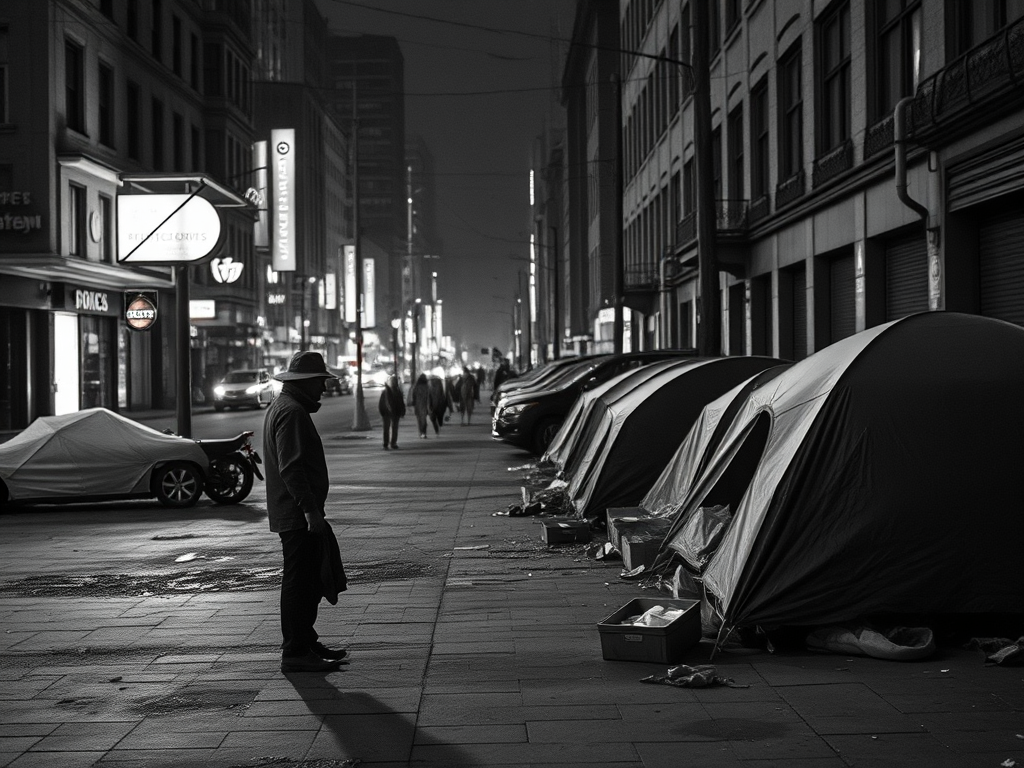
Ugh.


 The Poet Projects
Please leave a reply! No need to sign in :)