

While I’m working through the format and structure of this poetry blog moving forward, I’m going to keep posting with posts that walk through my thoughts on the poems I’ve written.
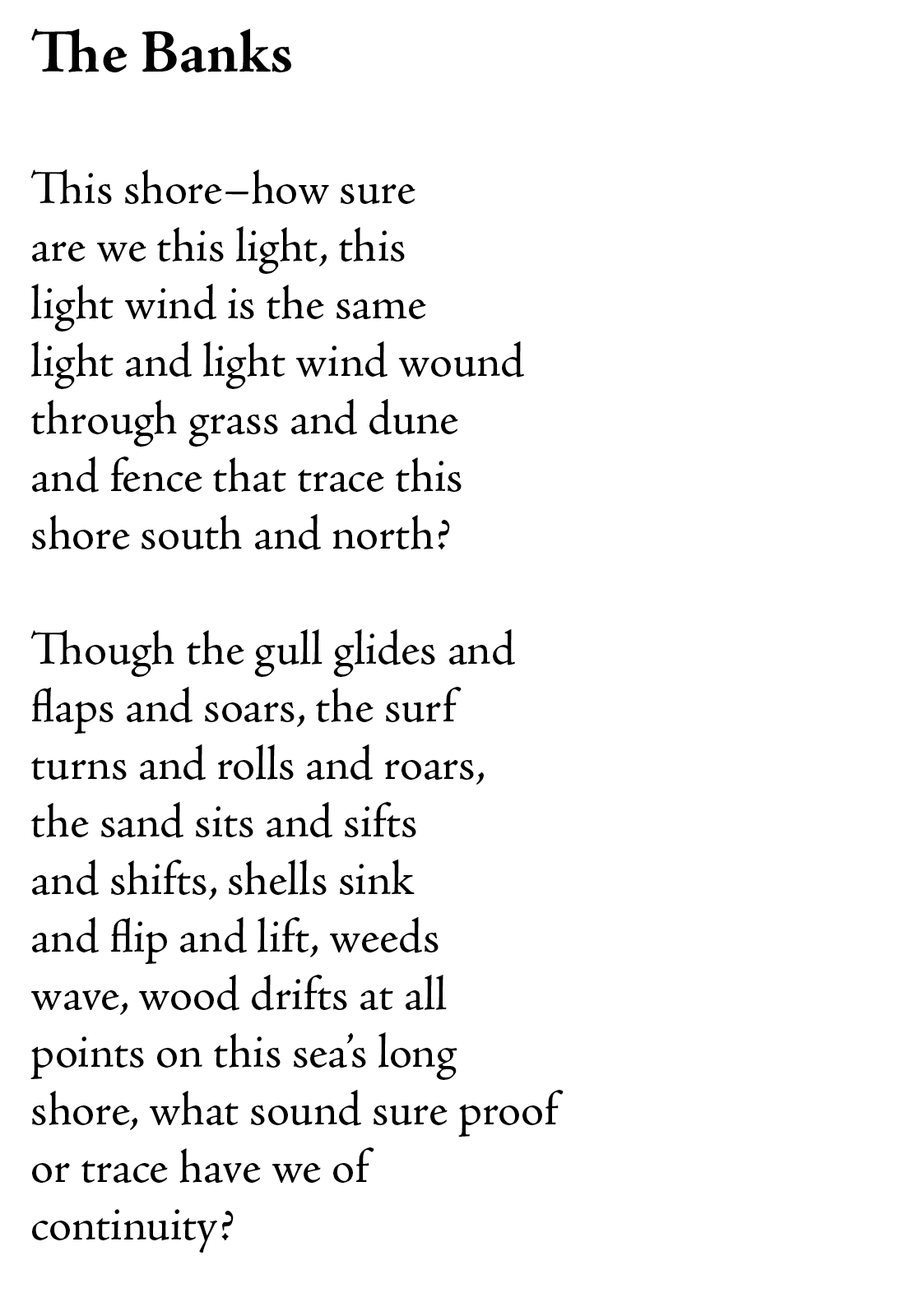
This poem, “The Banks”, was originally posted on November 6, 2023, written while my wife and I vacationed in the outer banks near Duck, North Carolina. It was the 22nd poem I posted here,
This was my first visit to the outer banks, a place I had heard of while growing up in Indiana, but knew nothing about, save that it was on the Atlantic Ocean.
What struck me as we arrived was how many, many houses there were here. For some reason I had it in my head, even at fifty-seven years old, that there were few houses each set on large beachfront properties with spacious beach between them.
Um, no. There are large houses for sure, but they are close together, for the most part, and though more remote, are similar to the houses I’ve seen up and down the Atlantic coast, in Maine, Massachusetts, New Jersey, Maryland, Virginia and other parts of North Carolina.
This is not to say they don’t amaze me. Nor that I have seen everything, every house up and down the entire coast of the Atlantic Ocean. There are parts of the outer banks, even where we were, that can only be reached with four-wheel drive vehicles when the tide is out.
Those are probably the houses of my earlier imagination.
But regardless of this house business, which is such a silly thing to be impressed with while at the beach while a giant body of water full of power and beauty and danger stretches east, north and south away from the spot I stand on, from the little bit of sand that is under my feet.
The correct term for the ocean is awesome.
And probably with all caps, italics, and bold with at least two exclamation points: AWESOME!!
This poem is about one part of that majestic sense of awe I felt standing there.
This is a lyric free verse poem, but I bound myself to a structure of four or five syllable lines, up until the last two lines which have six syllables.
I know I did this on purpose, but I can only guess what I was thinking, this being well over a year ago now.
The driving force of the decision is the word “continuity” which has five syllables.
Just a second–I change my mind. The poem should end on the word “continuity” and not change the structure for the last two lines.
The poem you read above is a revised version–completed just now as I did this analysis.
Interesting. I didn’t see that coming.
Here are the two stanzas side by side:
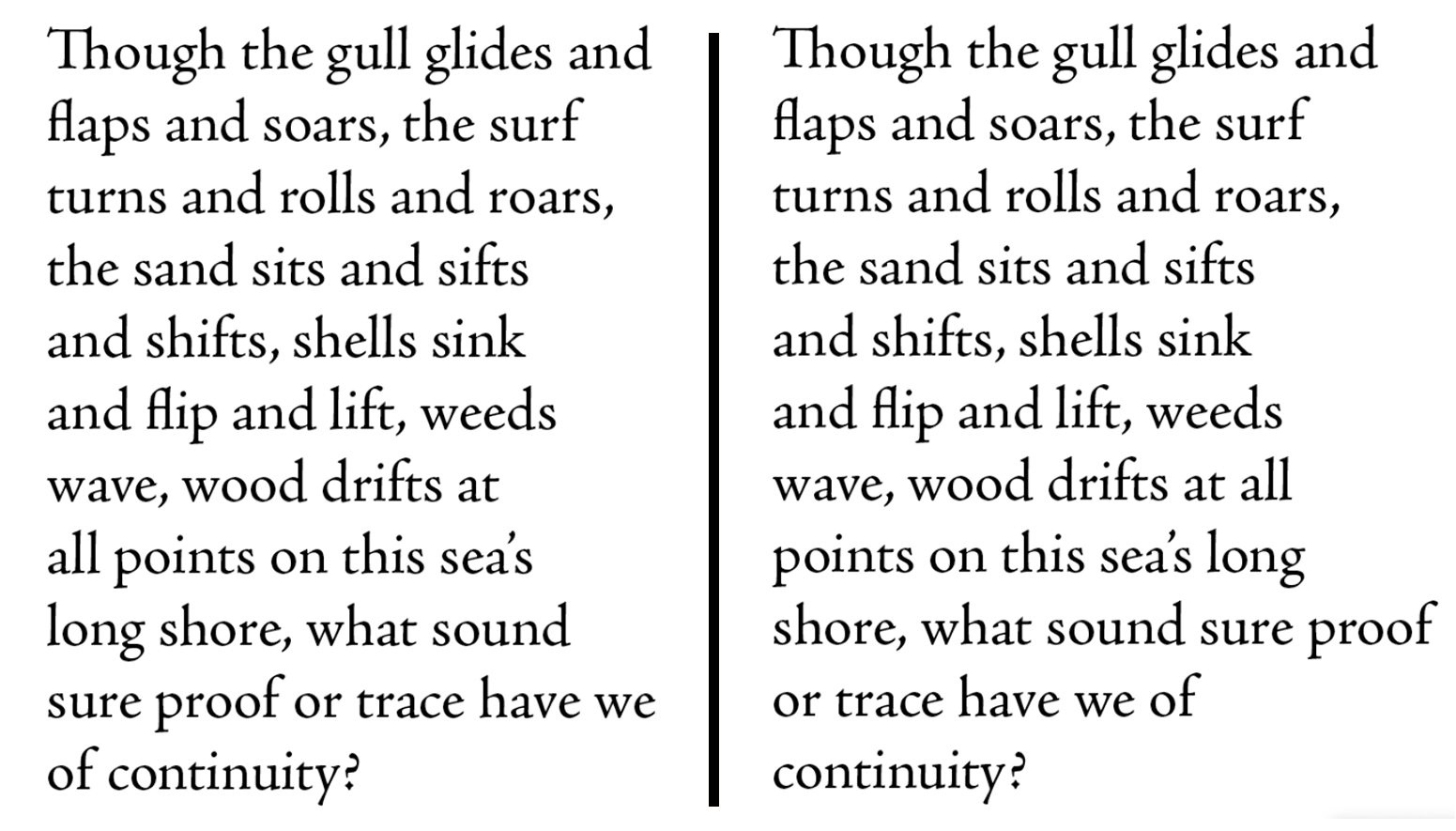
Well, that took a while to setup in Photoshop. No matter how quickly I think I can accomplish some task, I am always wrong.
So, although I probably chose to leave the last two lines at six syllables, as the original author, I get to change my mind.
One effect I was after here was to have the poem sound like the shore, the waves rolling in over and over, the gulls above, the wind blowing, the constant roar. Overall, I think I found it, at least a bit.
I hit the “s” and “sh” sounds, the “w” sound, the “ft” sound, those are the sounds of the sea, of being on the shore with the ocean right there beside me.
That’s not the only way the ocean sounds, though. At dusk and going into night, the ocean gets quieter, the sounds soften, the wind dies down as it shifts direction from inland to out to sea.
I am most proud of that last line, that last word here, “continuity”. It is not just an abrupt thought, going from sounds and senses to a concept, a principle of physics and math, a type of infinity, it is also an abrupt visual change–one word versus four or five words per line, one word with five syllables versus every other word that only has one.
And not just that, but the sharp “c” (or “k”) sound is jarring as well amid all of these softer sounds that have repeated so much you might expect them to go on and on.
There is another contrast here, that these sounds and scenes at the shore have continuously played since well before recorded history, so far back into time they seem endless.
And we can and should imagine that they will continue to move forward in time as well, truly continuous.
But what about north and south? As continuous as this vision of the shore is right there, is it really continuous?
I put one word in here that is our human intrusion on the beach, “fence”. That one word breaks the temporal thought of continuity, but also will clearly break the physical north and south continuity. There will surely be places where humans will not have put fences.
And of that, the word “continuity” also hints of human continuity, the continuity of life of not just human existence but in this case my personal life. It also stretches back and will stretch forward, but how far? And how continuous are the parts of that life?
I’m struck as I write all of this how intentional it all seems, but when I wrote the poem, though the ideas were there somewhere, not until the poem took shape, until I began writing, only then did I recognize things that were happening–the sounds, the mono-syllabic words, the four or five syllables per line, that repeating in threes is meaningful, that repeating words multiple times echoes of the shore and of continuity.
I love the photo here though it is not of the ocean but the bay on the western side of the island where we were staying.
The bay side is so much different than the ocean side–softer, gentler, quieter, more peaceful but also stunning and awesome.
And now I’m running the poem through WordPress’s AI image generator. I anticipate waves and sand and seagulls. Let’s see what we get:

Nailed it. And even grasses and fences!
I also ran the poem through Chat GPT for analysis and this was the first line of its report:
This is a beautifully lyrical and philosophical poem that explores the uncertainty of continuity and perception in nature. Let’s break it down into its structure, themes, and literary techniques.
And then Chat GPT went on to do a very thorough analysis of the poem. I asked it then what it thought about the syllabic structure of the poem. It noticed that the last word was multisyllabic but commented that the rest of the poem used one and two syllable words.
So I said, “It seems to me there are only one syllable words up until the last word. Can you comment on this?”
At which point it said that this was a “remarkable structural choice”.
Thank you for the kind words, my AI friend!
I then had a meaningful conversation with my AI friend, talking about other poets who have used such techniques and the significance in their poetry.
The “conversation” was very surreal, on the border of science fiction and fantasy.
On the other hand, wow.
 The Poet Projects
Please leave a reply! No need to sign in :)