My name is Jay Lance, and I’m a private detective. This world is full of clues, but only a few can find them.
It was a dark and stormy night on a bright sunny January day and there was a mystery to solve.
The mystery, really, was how to come up with a subject for a poem. I spent yesterday and last night throwing words at a page but none of them stuck.
And then my phone dinged this morning. “A bird!” I thought.
And then this poem.
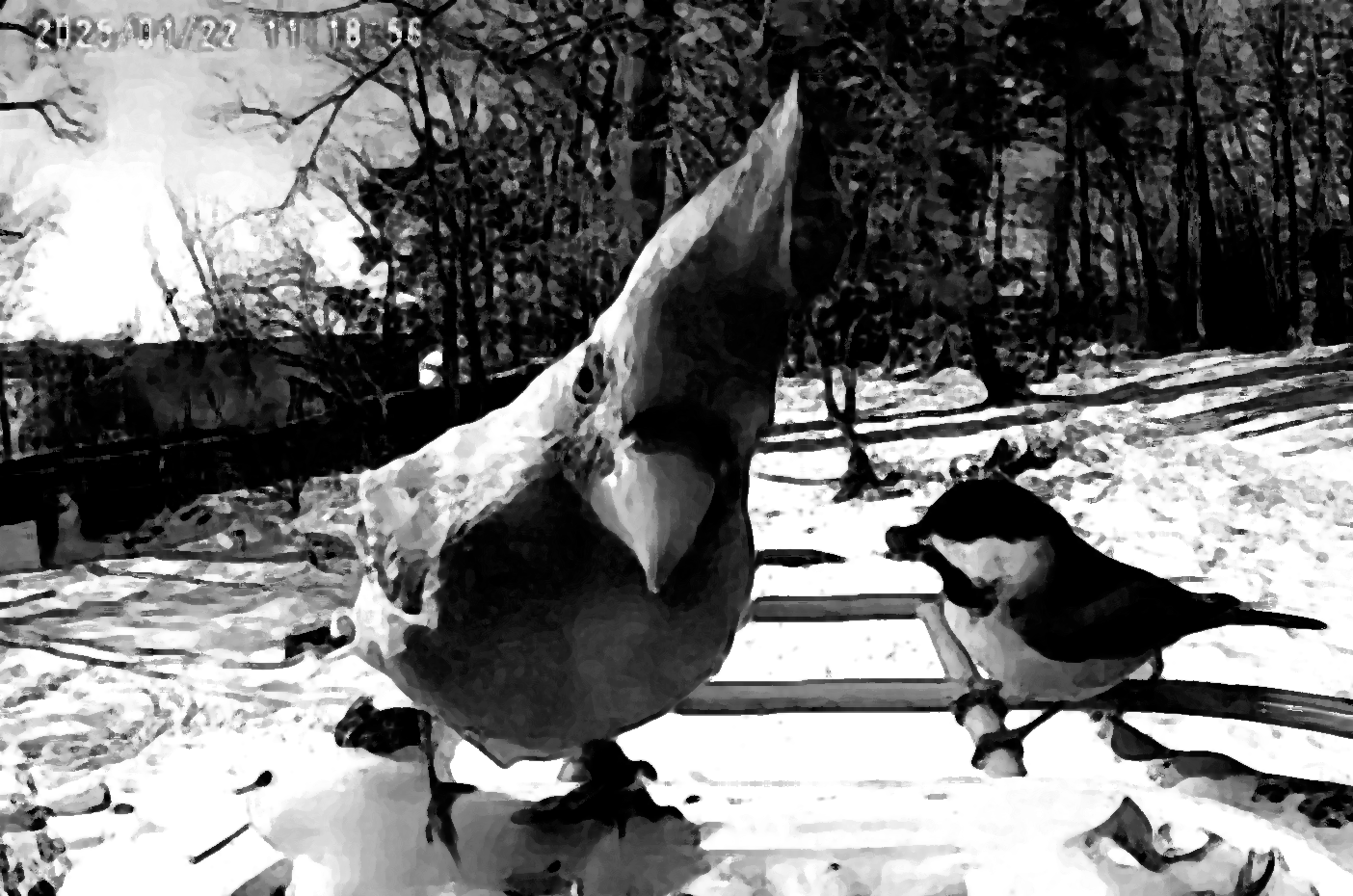
Most of this narrative poem is true. My daughter Anna and her partner Owen gave me the bird feeder for Christmas just over a month ago. Only two birds have found it so far, a cardinal and a black-capped chickadee.
And I have no idea why it’s only two.
The story of the hawk and the starling is also true. The dogs had just rushed out into the yard from the garage seeking things to pee on when a black bird fell from the sky into the snow. To my left a hawk briefly landed in the dogwood tree in our front yard. As soon as the starling recovered it took off, the hawk following then drifting a bit higher, suddenly smashing into the starling knocking it out of the air.
The hawk landed on it, clutched it in its talons, and took off with its prey.
The contrast between the world I’m capturing at my feeder and the violent world of raptors is amazing to me. The feeder is on the other side of my house, but I have no doubt that if hawks are hunting the edges of the woods I live in then the birds and other small critters are scared, very scared.
I was actually scared for my dogs when I saw the sharp-shinned hawk in the sky, its wings and tail full and facing us, a sight I’m sure is encoded in our DNA to elicit fear so that we can run away.
Instead, the dogs and I watched the show.
It would be wonderful to think that this poem came to me fully formed, knowing that I would explain the scarcity of birds at my feeder with the story of the hawk.
In fact, not until I introduced the detective elements of the poem did I actually make the connection.
The hawk may have been a Cooper’s hawk instead, but was one of these two and not the more common red-tail hawk I see almost every day in this area. The banded tail feathers were my clue as I am color-blind and can’t see the red of the red-tail.
I used Merlin Bird ID and am fairly sure I’m right here.
The humor of the poem, which I think is there, the word-play on detective tropes and the narrator’s inability to identify a cardinal and a black-capped chickadee while knowing the sharp-shinned hawk and starling, is tricky to employ for me. I’m trusting my instinct on this one, that the humor helps the sharp contrasts of the poem work, the whimsy of using technology to see the world of birds versus the dark world of predator and prey on the other side of the yard.
Mary Oliver would probably suggest that sure, it can work, but I should tighten the poem before releasing it.
She also would not like that mixed metaphor–tightening something before letting it go. That doesn’t make any sense.
I should be so lucky to be criticized by Mary Oliver.
The image is photoshopped from two shots from the feeder. Any cardinal would scare away a chickadee, I’m sure, as large birds in general do with smaller ones.
I’d like to think they could be friends though, that I can manipulate the world and idillify it.
And that’s not a word, “idillify”, though if it becomes one I’ll take credit–as of now my PI skills, which includes only using Google, say it is not.
As the images from my feeder are also timestamped, this blog post serves as my flag of conquest.
One last note–the title for this poem was the first thing I wrote which has only happened rarely. That it provides such a rewarding summary of the poem, two connected stories each about two birds, was lucky though also, to me, the perfect title for this poem.
However . . . now that I’ve written the tag for this post, “It was the best of times, it was the worst of times” perhaps I should change the title to “a tale of two birds”.
Alas, that’s my story and I’m sticking to it.
 The Poet Projects
Please leave a reply! No need to sign in :)