
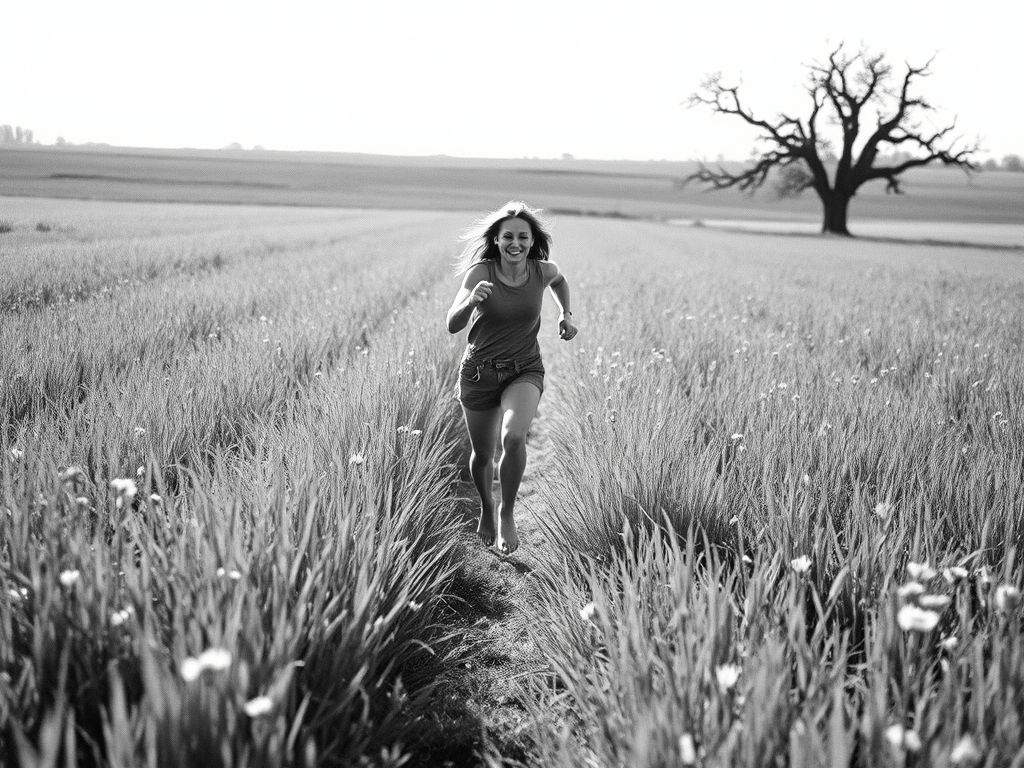
Many of the poems I write for this poetry blog are experiments in style, but none more so than my poem “Pale fade arise moths dew” which I posted on August 16th, just over a month ago.
Here is the poem in full:

I always post a small aside about each poem or blog, something that I hope helps my readers decide if they want to read said poem. WordPress refers to these notes as “excerpts”, and, if you want, will write them with AI.
I have tried this a couple of times but have always found it off-putting. In the case of my poems, the AI cannot read them to interpret, as they are presented with pictures, not as text.
In the spirit of discovery, though, I had the AI interpret this poem. Here’s what it had to say for its one hundred word version:
The post expresses a yearning for an unrestrained experience in a vast, open field. The imagery of running barefoot through the farm evokes a sense of freedom and connection to nature. It reflects on past moments of bliss and the tranquility offered by the surrounding trees, suggesting a contrast between the comfort of the familiar and the allure of uncharted horizons. The mention of “moths” and “dew” emphasizes fleeting joys found in simplicity, while the overall tone conveys a longing for genuine happiness and deeper understanding amidst the complexities of reality found in simplicity, while the overall tone conveys a longing for genuine happiness and deeper understanding amidst the complexities of reality.
Wow! I wrote a pretty good poem, didn’t I?
Here’s its twenty word version:
The content expresses a desire for freedom and connection with nature, highlighting themes of openness, comfort, and fleeting happiness.
Well, I have to say, that’s pretty close to at least the basic meaning of the poem. No matter that I scrambled the words, that AI was able to come up with this. Clever girl.
On the other hand, the poem isn’t supposed to be completely opaque. The concepts are there, but the experiment was to concentrate on the sound of the poem more than the meaning.
One way to do this would have been to write a “normal” poem first and then transform it, possibly by just scrambling the words. That might work.
That’s not how I did this, though. I first wrote the poem you see, at least up to a point. Then I wrote a “normal” version of the poem that approximated the meaning I was after.
You can see that process in this animated gif:
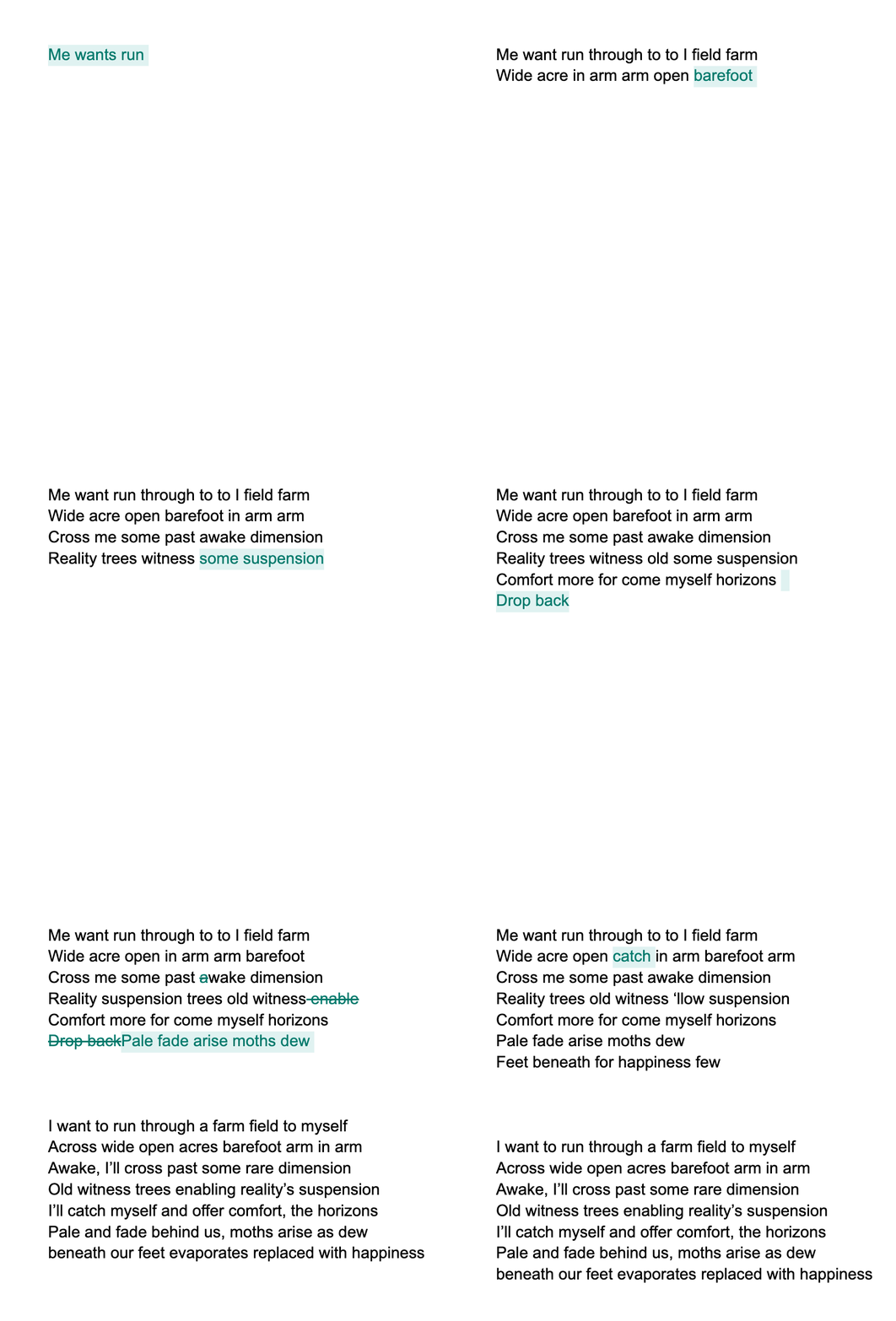
Here is the “normal” poem by itself:
I want to run through a farm field to myself
Across wide open acres barefoot arm in arm
Awake, I’ll cross past some rare dimension
Old witness trees enabling reality’s suspension
I’ll catch myself and offer comfort, the horizons
Pale and fade behind us, moths arise as dew
beneath our feet evaporates replaced with happiness

I hate it. I really do.
I’m sure glad that wasn’t the poem I posted. I dislike it so much it makes me wonder about the experimental poem I did post.
Right away I see a discrepancy, at least if the poem has a temporal order. When I run to myself across the farm field barefoot, I don’t see how I can also be arm in arm with myself. Of course, the poem plays with the idea of parallel dimensions, of suspending reality to allow this to happen.
So why not then? I can run to myself with myself. That makes perfect sense!
Or not.
What I really do like about the poem is the sound. I’ve read it out loud many times now and it just all fits.
The inspiration for this style came from E.E. Cummings’ poem “[anyone lived in a pretty how town]”. If you don’t know that poem you can read it here.
Even as I say that, it isn’t quite true. When I started the poem I wasn’t thinking about any other poem at all. I was just listening to the words flashing through my head. As I read it to myself out loud, though, I can of course hear it so clearly.
Cummings’ poem accomplishes so so so much more. Hearing him read it is powerful (which you can do here).
That’s the way I hear almost every poem in my head–read slowly, words enunciated, some tape or phonograph hiss.
I did a very archaic poetic thing in the poem, removing the “a” in “allow” and putting an apostrophe in its place: ‘llow
I’m not sure this is technically ‘llowed, but I did it anyway. I said that line in my head over and over and ‘new that it had to be done so that the words “flowed off the tongue” so to speak.
My personal poetry rules, whatever they may be, ‘llow me to do something like this every once in a while, but as part of those rules it could easily be overdone. I’m not sure why I believe this, but I do. It’s ok here, but not everywhere.
My favorite line is also the title: “Pale fade arise moths dew”. I just really enjoy saying it out loud.
It doesn’t really matter to me whether it has meaning, though it does. We poets, and I suppose everyone really, love the way certain words sound together.
“Pale” is an interesting word. Depending on how you say it, it can have one or two syllables. The dictionary only gives it one, but take a second to say it out loud and you can hear the second syllable.
If you want to.
The first time most of us, I’m guessing, learned about syllables we also learned about stress, as in which syllable of a word is stressed. I’m also guessing that the first time we learned that the placement of words in a line of poetry often relies upon these stresses was when we read “Romeo and Juliet”, the first Shakespeare play taught in most American schools.
During that lesson we learned what iambic pentameter was, and depending on your teacher and your interest, realized that some lines don’t quite fit that pattern.
My teacher, at least, Mrs. Sponseller, explained that this was done on purpose to place emphasis in different ways.
I remember the math and logic center of my brain being triggered at that point, caught up, as it always is with patterns.
I almost never think consciously about such matters as I write poetry. With this poem, for example, I was really concerned only with that overall sound. When I got to the word “allow” though, well, then I noticed.
And what I notice now, as I wrap this up, is how my favorite line “pale fade arise moths dew” stands out in the poem because of syllables and also because of its length. It is the shortest line by length and syllabically.
Because of this, it is the focal point of the poem. I can hear it when I read it out loud. I can see it as I look at the page.
But until right now I had not noticed. I just knew that I liked that line.
So much of what we do creatively, whether it be writing poetry, painting, writing music, or something else, happens beyond our reasoning minds.
Really, this goes well beyond creativity. Catching a ball is a great example. If you had to run the physics equations that explain the ball’s parabolic path based on its angle of release and initial velocity there is no way we’d catch that ball.
But so often we do.
So do my dogs.
Life is a wonder, isn’t it?
Speaking of wonders–one last thing. I asked the WordPress AI to generate a black and white picture that would fit with the poem, which is the featured picture of this blog.
Life isn’t the only wonder, I guess.
Here’s the picture it generated for this blog:
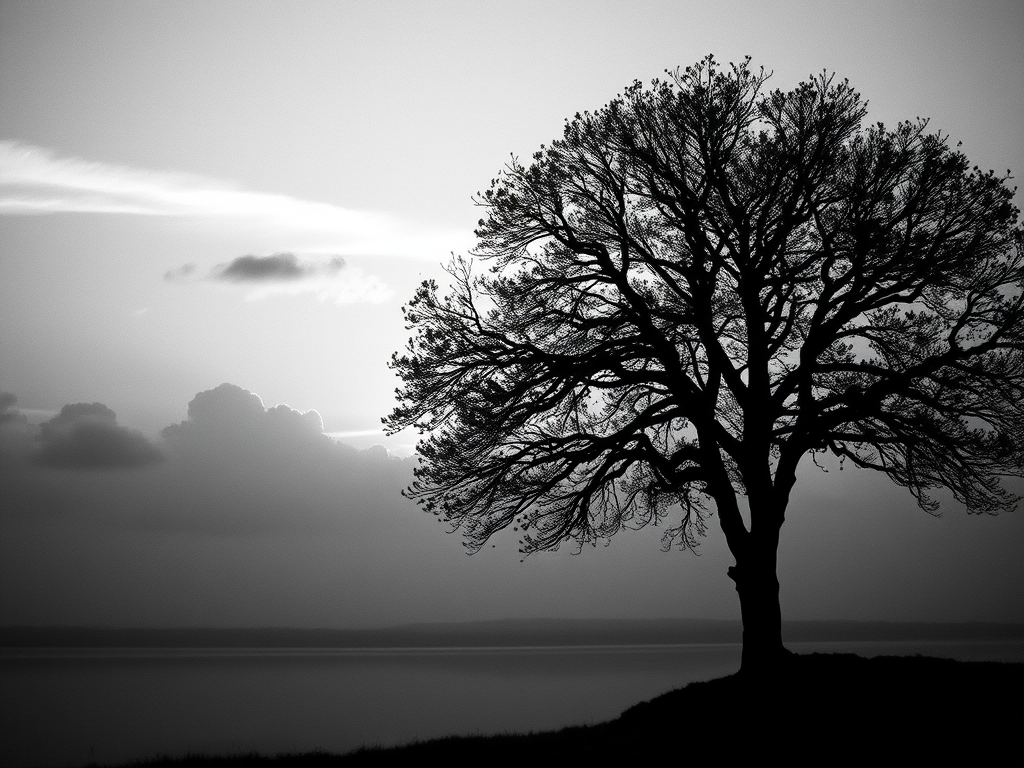
You pretty much amaze me, AI.

 The Poet Projects
Please leave a reply! No need to sign in :)