

If you’ve been here with me for a while, you will have noticed the Marla series of poems that I post on Mondays. If so, I hope that you enjoy them. I certainly enjoy writing them.
The Marla poems are an experiment in telling a non-linear story with poetry. There is no direct story line or arc to Marla’s life. Or if there is, the arc must be deduced from the poems.
There is also no story in my head about Marla, nothing written down, no poems that I know ahead of time I will write.
In fact, I wrote the initial eight poems back in December of 2012 when I was on sabbatical from teaching and dedicated three hours a morning to writing poetry while I finished my MFA from National University.
Also in fact, I do not remember writing them.
I found them in my folder of poetry where I keep track of all of my poems, numbering each of them. From this era of my poetry life I have one hundred and thirty-seven poems in order of when I wrote them. It appears that I wrote the Marla poems late in that sequence but they were not part of my degree or any class that I took.
At least I don’t think so.
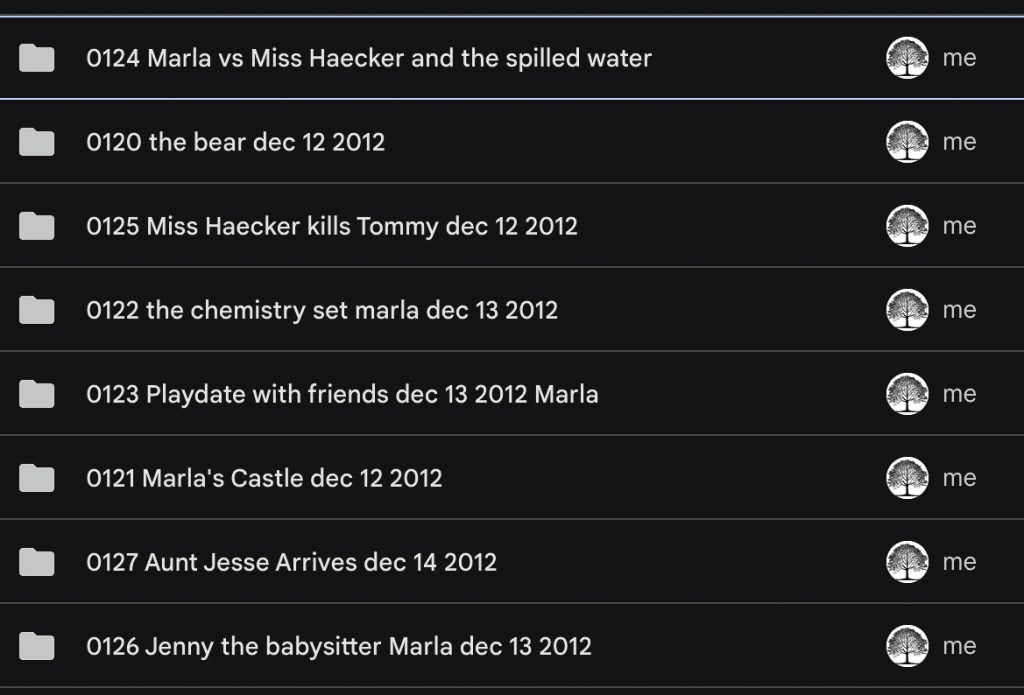
My memory is not terrible, so in this case I’m not sure what happened. It could be magic. I might have written them while I was sleeping.
I was overjoyed when I discovered them, though. Because I had forgotten them, I was able to experience them as any reader would.
I edited the poems before I started sharing them here, at least a little. My critical eye has grown and I have a sense of when a poem is ready. Most of these seemed ready.
There is one poem of the bunch that I have not posted yet. In that poem Marla’s parents find a dingy toy store in the city and shop for a chemistry set for Marla. In that poem you learn more about her parents, how they view Marla and how they try, at least a bit, to explain her to others.
My favorite poem of this series is “The Bear Under the Stairs”. I have this faint idea that this poem surprised me and set me to write more Marla poems.
The plot in this story is pretty simple–Marla is a kid with an active imagination playing pretend, except it turns out that she isn’t playing pretend and her father loses his arm because even he didn’t know this.
It seems like I should continue the story of the bear–does she keep him? Does he become tame?
Except I’m trying not to think that each bit of the story must be told. And of course, I don’t know the story.
When I write the new Marla poems I don’t know where they are headed until partway through. “Grandma Mabel” is a great example of this. When I started the poem I first was planning to write about Marla’s mother.
And then Mabel showed up.
Right away the structure of the poem took shape, with these cascading appositives allowing me to describe Mabel, and later Dr. Peabody, in greater detail but not just as a series of narrative sentences, as one would in a story.
Is this poetry? Sure. Why not?
Are these actually appositives? Well, here I’ll just say, I think so.
Do they make the poem confusing? You bet.
In fact, I went back and added the single word lines “Mabel,” and “Dr. Peabody,” to help keep track of whom I was talking.
As for “who” or “whom” I really have no idea if I did things correctly here. But, I’m not concerned if I messed up. Technically, “who” can be used as an appositive while “whom” is used as a direct object of a preposition.
I simply chose the word that felt right. I could be wrong, but I feel right.
Only as I got to the end of this poem did I realize that (spoiler alert) Dr. Peabody is Marla’s grandfather. That is the implied secret of the poem, one that I didn’t see coming until I was done, and then there he was.
Dr. Peabody has already been in a Marla poem, though without his name, at that point the doctor that delivered Marla after the doula put a buckeye in Marla’s mouth in “Marla’s Castle”.
I reserve the right, not that I really need to say this, but I reserve the right, which I say as I used to say “same seat” when I’d get up off the couch and didn’t want my sisters to take my seat, so I reserve the right to go back to any of these poems and fix the discrepancies that develop as I write them.
There is already one that I found–the color of Marla’s eyes are steel blue in one poem and gray in another.
Which, I’ve been thinking, might be ok, especially if I eventually discover that Marla’s eyes change color frequently. Maybe they are like mood rings, though that seems a bit too simple.
And speaking of simple, although at first I thought these might be children’s poems, once Marla’s dads arm got ripped off, I knew they couldn’t be.
I’m sure that I was thinking about Roald Dahl’s story “Matilda” when I wrote the first Marla poem, especially later when she battles her second grade teacher.
I think when Miss Fevrile kills Tommy, one of the children in Marla’s class, I also cross a line that I don’t want to cross in my poems for children.
There are many examples of stories where the main character is a child but the book is clearly for adults. “A Prayer for Owen Meany”, “David Copperfield”, and “Huckleberry Finn” are all examples of such books.
Now, I don’t mean to imply that these Marla poems, when they become a book, will have anything in common with these literary masterpieces. But, I also don’t not mean to say that.
Let’s just wait and see. I’m looking forward to finding out.

 The Poet Projects
Please leave a reply! No need to sign in :)