

I just finished the first draft of the poem “Emptiness”, as I am currently calling it, and thought to myself, “Why not jot down my immediate thoughts about the process, the poem, and the choices I made while constructing it?”
And so, here you go.
The poem took about forty minutes to write, give or take, some of that time spent considering the next word, where to break lines, re-reading the poem so far and making choices about its direction. Some of that time was answering a phone call, declining other calls, refilling my coffee mug, jotting disconnected notes on a piece of paper as they came to mind.
That is part of the whole process of writing for me. Because I am easily distracted, I keep a piece of paper or a notebook next to me and write down thoughts that are not connected to the process, thoughts that I want to come back to. Especially with a poem, though it is mostly true for the prose I have been writing, I need to keep working on the process or I will lose the thoughts that are bubbling up, that my subconscious mind is leading myself to.
This poem started with just noticing that my coffee mug was empty, in this case for the third time. I had written the first line of a poem down already this morning–”I spent the day gathering pencils”–and I knew that I was going to write a poem today. I took the thought of things being empty instead of the gathering pencils idea and started writing.
My process for this poem was to open a text document on my computer and start typing. Sometimes, though not this time, I write with a pencil or a pen.
At the start of a poem I try to follow the first thoughts that come to mind. In this case that was to create a list of all the things around me that could be called “empty”. At no conscious point did I anticipate that emptiness would go from objects in the physical world to the lives of humans, but of course that is where I ended up.
My poems of late, and my prose, have been composed of long sentences that interconnect thoughts and wander around a bit until I type/write a period after them. That is a pretty conscious decision for me.
As I wrote this poem I stopped a few times to read the poem out loud to myself–that has a lot to do with where I choose to end sentences. In this case I arrived at a point where I could hear the poem spoken out loud even as I wrote it. I could hear my voice rising toward the end with the cadence of the lists of three toward the end of the poem. For example, we fill ourselves with joy, hope and love, we fill our arms with burdens, baked goods, and others.
I cannot say that I made a conscious choice, not at first, to use the parallel structure of lists of three, but when I started to hear the poem spoken out loud that became an imperative, up until the end, where we only whisper one thing, our affection, to others who feel empty.
The poem, overall, feels pretentious and moves too quickly from a mindful observation of the space around me to a commentary on the condition of feeling lonely and the way that we can choose to change that condition for ourselves and for others.
That is a failing for me, in general, I think, first that I do this often, and second that I assume, without the feedback of anyone but me, that this is a pretentious thing to do.
The poems I create for this long-term project of mine–The Poet Projects–are meant to be created at one sitting, edited as needed for the moment, and then posted. As such I consider all of them drafts. Poems, above all writing, never quite feel finished for me. I am stuck on Poe’s thought from his essay “The Philosophy of Composition” that every word must be chosen with “precision”.
He doesn’t exactly say “should”, but in explaining how he wrote “The Raven”, Poe explains that the “work proceeded step by step to its completion, with the precision and rigid consequence of a mathematical problem”. So, at least in this one case, he is suggesting he did it himself.
I’m not sure that he isn’t speaking sarcastically about his own work or perhaps not telling the truth about how he wrote the poem.
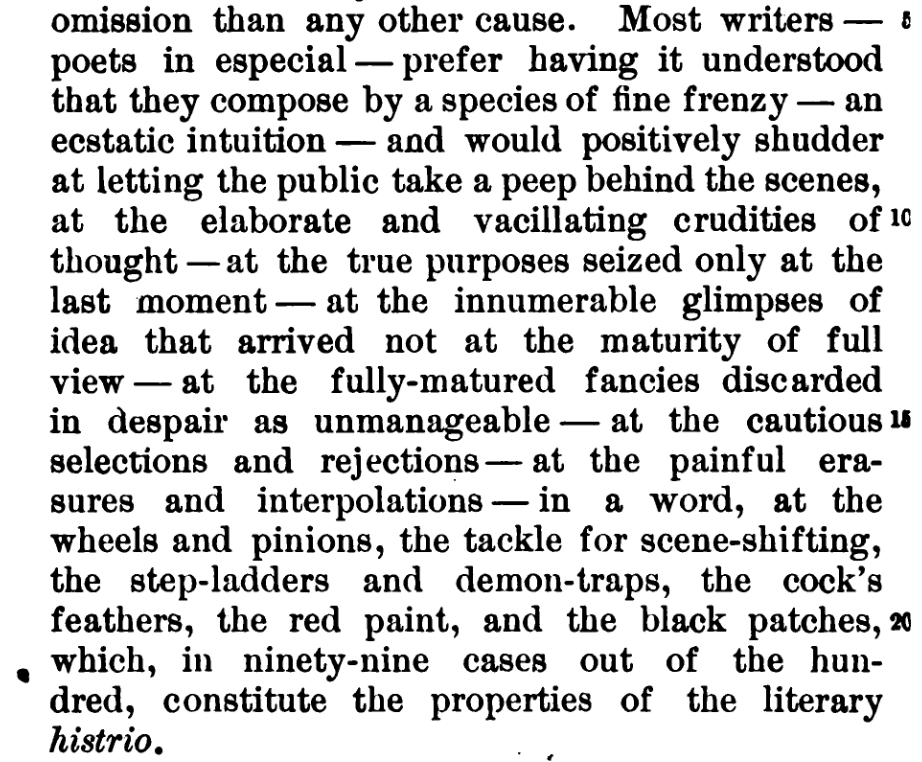
I noticed as I read his essay just now that this commentary I’m giving, about how I wrote my poem, is something (as Poe says) most writers “would positively shudder at the thought” of doing, letting “the public take a peep behind the scenes” of how I wrote it.
I’m pulling this phrase from Poe’s essay–”vacillating crudities”–as the title for this part of my website, this part where I comment on the poetry I am writing, trying to explain the process and thoughts behind each poem, as Poe says, “the wheels and pinions — the tackle for scene-shifting — the step-ladders and demon-traps — the cock’s feathers, the red paint and the black patches, which, in ninety-nine cases out of the hundred, constitute the properties of the literary histrio”. Quite apt.
And why not add another complication to the website? Not that the website is complicated, but that, as in a digital watch face or in the field of horology, another facet of the whole appearance beyond the most basic features, which, in the case of watch faces, is hours, minutes, and seconds.
And so, in creating this additional complication, I have, essentially, made the entire site more complicated. So be it!
 The Poet Projects
Please leave a reply! No need to sign in :)