

I have an inordinate need to fix things, though as with all such thoughts of mine, this is up for review. I have no idea how much other people also want to fix things, so perhaps this is an ordinary amount of wanting, or it is wanting when it comes to wanting, or perhaps I want to want to fix things, so the feeling is aspirational, as in because I want to be a poet I write poems so that I therefore am a poet, whereas the proof for this need to fix things being inordinate is otherwise wanting.
You can use a word too much; we all learned this in school.
In red pen our teachers would write, “You use this word too often”, the red pen emphasizing the need to fix said issue, the pen-color red now forever associated with correction and, a bit, reprimand.
Being colorblind, I was immune, you’d think, to this association, but I was not, as I do see the color red, at least a color I assume is red, though it is a color that might also be green or yellow or orange. Not black or blue though. When a teacher wrote to me in black or blue I was sure the pen was not red, thus sure that I was not in need of correction, or at least the teacher was not angry at me for making this mistake. For I have been corrected with all of the pen colors at one time or another, most often, I assume, as a way to pull one over on the colorblind kid.
This is a terrible thing to do, to intentionally misuse color to tease someone, or in general just to tease someone, and of teasing maybe this isn’t terrible, as there are other levels of making fun at someone else’s expense that are much worse than teasing, but on the base level they are all making fun of someone, which may or may not be terrible, but it isn’t nice.
The safest type of teasing I have found in my fifty-seven years is to tease myself, not others. I have certainly teased others, or worse, and in every case I can remember I regret it. Self-deprecation is a fairly harmless way to have fun, though of course I have taken this to extremes as well, and have regretted it.
Done too much, self-deprecation comes across as self-loathing, or humble-bragging, or insensitivity. For instance, I joke about my colorblindness, feigning a rough life because of it, at a level commensurate with being obnoxious, or at least a level where the joke isn’t funny.
At that point though I’ve often thought, “Well, if I keep going, maybe it will become funny again.”
And at some point along the way, someone used the word “colorblind” to suggest a reason why they couldn’t be racist. And there’s a good reason to never joke about being colorblind.
And yet I am colorblind and three days ago it actually was a problem. No joke.
As I said I really, really like to fix things. So, when my mom’s Nespresso machine stopped working, I brought it home so that I could fix it.
At no point along the way did I consider that I might not be able to fix it. This doesn’t mean that I thought it would be an easy fix, or a quick fix, or one that would not cost anything. I just thought, “If I take my time and do some research, I can fix this.”
Then I ran into a problem. Nespresso has a stylish machine that is sold all over the world, allowing the user to make a very nice cup of coffee or espresso regardless of their nationality. In order, I assume, to make the machines ubiquitous, there is no screen and no words on the machine other than “Nespresso”.
In fact, there is only one visible button on the very top, a button that does everything–switches between modes, resets to factory settings, descales, purges, cleans, rinses and brews coffee.
That’s a lot for a button but it’s not too much for a button. Consider Morse Code as an example. When sending Morse Code, the user only needs one button. Through a series of tapped signals, with longer and shorter durations, one simple “on or off” button can communicate virtually anything.
With all of the possible functions, it would be handy to have another button, which the machine actually does, a secret button, in this case the silver bar that opens and shuts the capsule chamber. This secret button turns the machine off if held down for three seconds, or switches between modes when tapped one, two, or three times while the machine is in special operations mode.
How, though, would I know if the machine is in special operations mode? One button, even two buttons cannot tell me. The machine needs to communicate back to the user, telling them about the machine, i.e. is it brewing coffee or does it need descaling or is it in special operations mode?
And this communication is done with (pause) color. In this case three colors–red, green, and orange. The exact three colors of LED lights that I cannot distinguish.
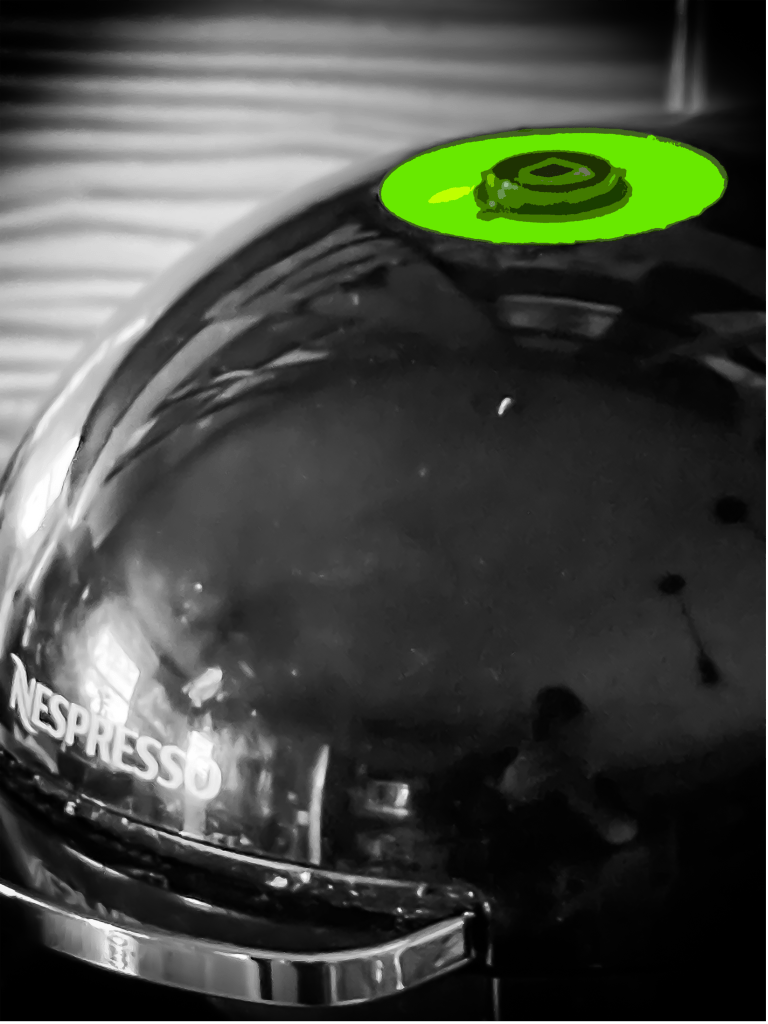
So, when the machine was telling my mom that it needed to be descaled, indicated with the circular light around the button shining half green, half red, I had no idea.
In fact, I made a poor assumption early on–I assumed that the light was aesthetic, meant only to look stylish, hip, chic, cool. Well, certainly it was meant to be those things, but the shoes, so to say, are also quite functional.
Other than to ask someone else, there was no way to know what the machine was telling me, and unless someone else was around, I was stuck.
Using context clues though, and experimenting with various button push frequencies and simultaneous pushes and then counting the number of light flashes in three seconds as well as whether the light was spinning or stationary, I eventually figured out that the button itself was simply broken. Sometimes it worked. Most times it didn’t.
So, I called support. Thirty minutes later, following an extended video session and much complaining on my part of the use of color as an indicator, the support technician, who was clearly done with my naivety and my use of vinegar as a descaling agent (“It will ruin the machine! Ruin it! It will destroy the delicate parts inside!”) told me, “I think the button is broken.”
“That’s what I’ve been trying to tell you!” I wanted to say, but I felt sorry for the technician, even though they could see the amazing three colors of the button and I could not.
I also found out that the unit was not under warranty, but if I could mail it back it would only cost $65 to fix the button and send it back.
At that point I said, “Thanks for your help!” and instantly searched Youtube, finding a sixteen-second video that promised it would solve all Nespresso VertuoPlus button issues.
Sixteen seconds later I had a screwdriver in hand and had pried the metal housing of the button off, revealing a silicone membrane and a lot more exposed light.
Machine fixed.

The housing it turns out keeps the button pressed on after a couple of years, the edge wearing away just enough that it can get caught under the metal edge.
I had plans to replace the entire button, to take the machine apart, to rip and tear and set the tiny screws and springs aside in hopes they would fit back in. Alas, I was done. My fixation on fixing needed to find another item wanting to be fixed.
At that point an Amazon package was delivered and all three dogs looked up.
“Not you guys,” I said. “You’ve already been fixed” wink, wink.
Wendy has noticed that I talk to the dogs a lot, about a lot of things that, as dogs, they could not possibly understand, to which I say, yep, I do. And maybe they do understand, more than you’d think. They are, at least, good listeners.
Though I cannot find the owner’s manual to check, I am pretty sure they are also colorblind, so even if we could have communicated, if I could have asked Fairlee or Louie, “What color is this damn button?” they would not have known. But I do know, given their generous nature and loving dispositions, they would gladly try to solve any problem they could, at least the little two pups, our mini goldendoodles.
Remy, on the other hand, he’d love to help, I’m sure, but he is younger and so easily distracted. Flashy lights, silver things, squirrels, deer, loud sounds, leaves, water, dirt, air alike would take his attention long before he could reason out that the button was the problem, that it would take a simple pry with a flathead screwdriver to fix, that oh, wait a second, what’s that bright metal thing on the counter? Wendy’s cookie scooper? It’s in three parts?
Where did I leave those damn pliers, Remy? I just had them a minute ago. C’mon you guys! It’s go time!

 The Poet Projects
Please leave a reply! No need to sign in :)